


MARCANTONIO FRANCESCHINI
Bologna, 1648 – 1729
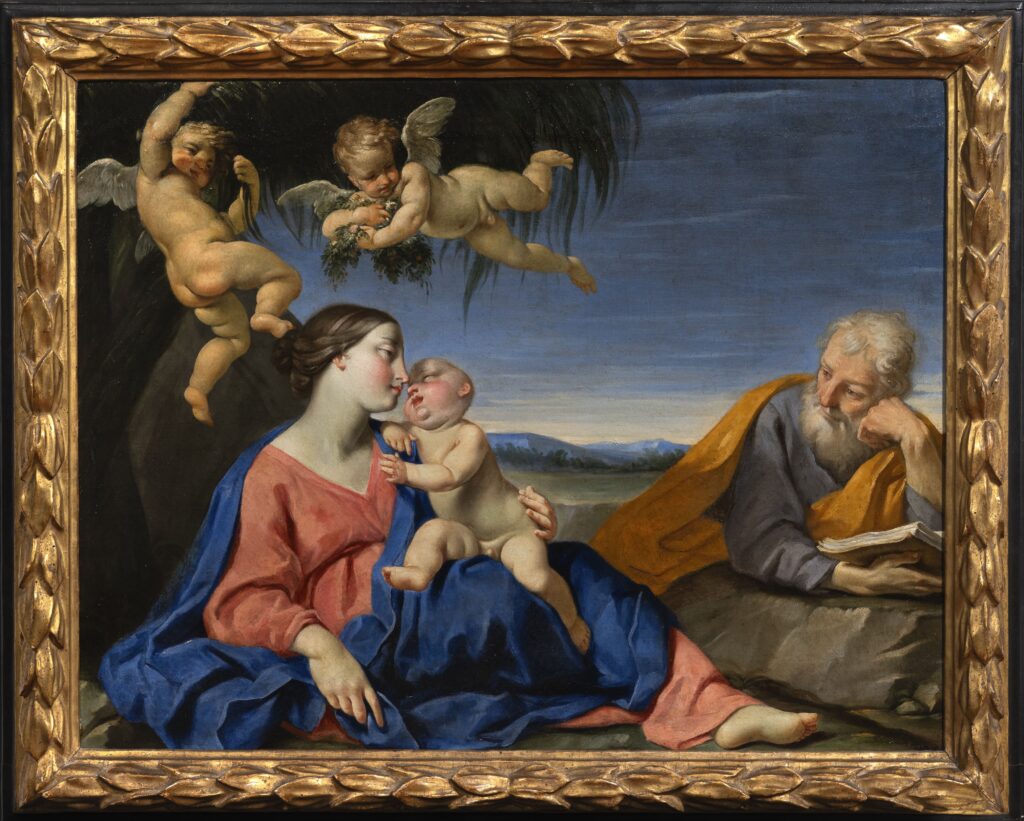
The rest on the flight into Egypt
oil on canvas, cm. 67×86
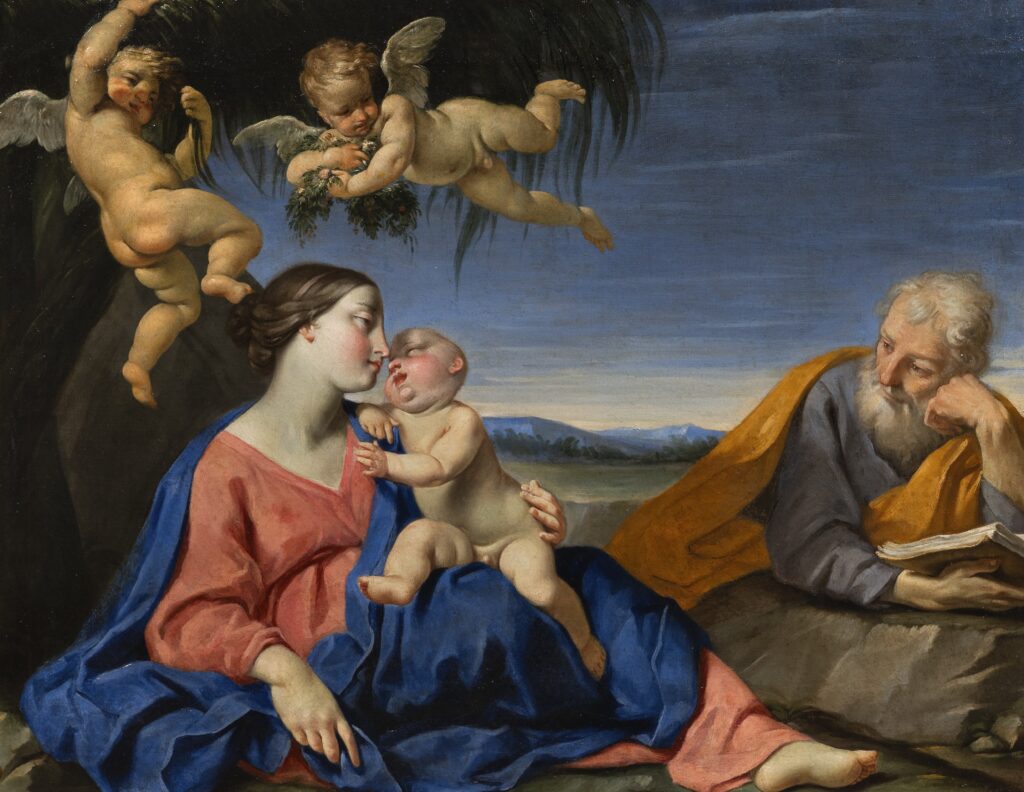
The painting depicts the episode of the Rest on the Flight into Egypt, a subject widely represented in the Christian figurative tradition and drawn from the Gospel of Matthew, here rendered with exceptional emotional delicacy and a refined chromatic sensibility. At the centre of the composition stands the figure of the Virgin Mary, seated and covered in her traditional blue mantle, tenderly supporting the Child, who turns towards her almost as if seeking shelter, thereby conveying a sense of calm and familial protection. To the right of the scene, Saint Joseph is shown in an isolated, contemplative posture, his head resting upon his hand as a mark of both physical fatigue and inward reflection, while above the group two winged putti hover, their angelic presence signalling divine protection at a moment of imminent danger and evoking the urgency of the flight from the threat posed by Herod. The luminous, softly rendered landscape further enhances an atmosphere of serene contemplation, where the naturalism of gesture and the gentle modelling of flesh tones—particularly in the figures of the Virgin, the Child, and the angels—imbue the scene with a harmonious balance between domestic intimacy and spiritual dimension, a hallmark of the poetics of Marcantonio Franceschini, to whom this painting is confidently attributed. Beyond the subject itself, which Franceschini addressed on several occasions, particular iconographic and stylistic parallels may be observed in the careful depiction of familial intimacy, most notably in the figure of the Child, which recalls comparable compositional solutions in the Charity of the Gemäldegalerie Alte Meister in Kassel, as well as in The Birth of Apollo and Diana, preserved in the collections of the Prince of Liechtenstein in Vienna. The rediscovery of this painting thus represents a significant contribution to the understanding of the artistic development of one of the foremost figures of Bolognese painting at the turn of the seventeenth and eighteenth centuries. Franceschini established himself as a leading exponent of the late Italian Baroque, distinguished by a vast oeuvre encompassing both fresco cycles and easel paintings, characterised by harmonious compositions, elegant gestural language, balanced spatial organisation, and sophisticated chromatic refinement. He emerged as one of the principal interpreters of academic Bolognese painting of his time, working within the classical tradition transmitted from the Carracci, via Francesco Albani, to Carlo Cignani, Franceschini’s favoured master, to whom he remained closely aligned in both stylistic sensibility and compositional elegance.