


Anonymous painter, after Raffaello Sanzio
late 18th – first half of 19th century
School of Athens
oil on canvas, cm. 162×216
Between the eighteenth and nineteenth centuries, the practice of reproducing famous works became widespread, both as a teaching tool in art academies and as a substitute for originals in private collections or as a travel souvenir. This phenomenon is essential for understanding the history of taste, the circulation of iconographic models — often derived from prints and engravings — and the revival of techniques that had fallen into disuse.
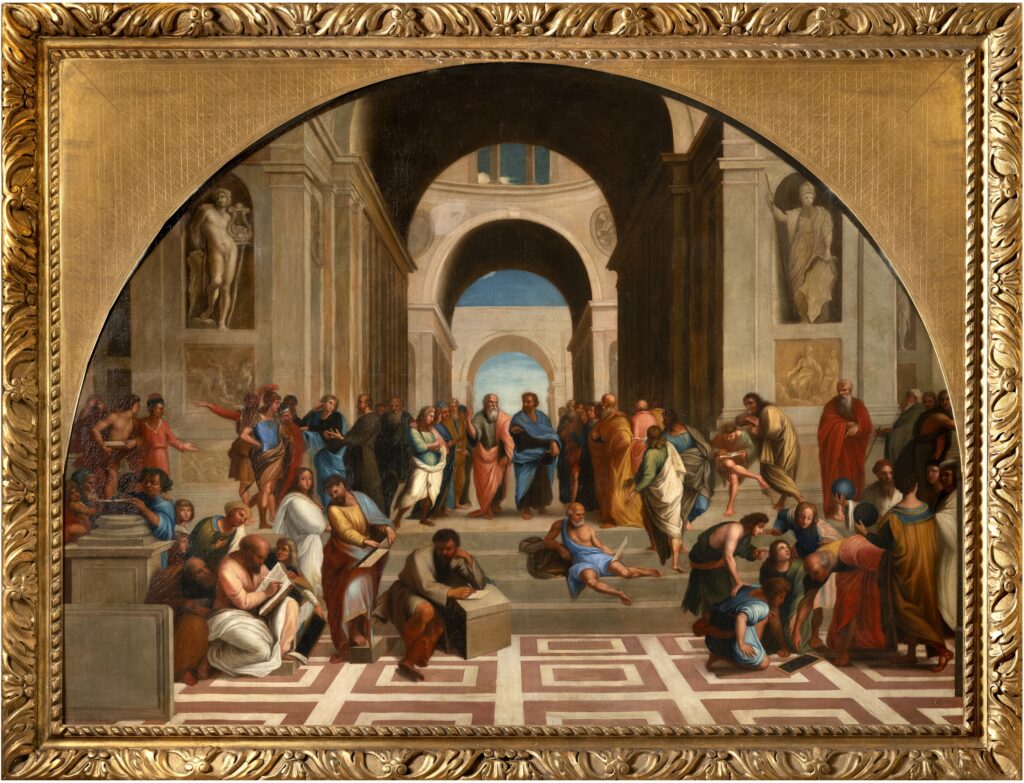
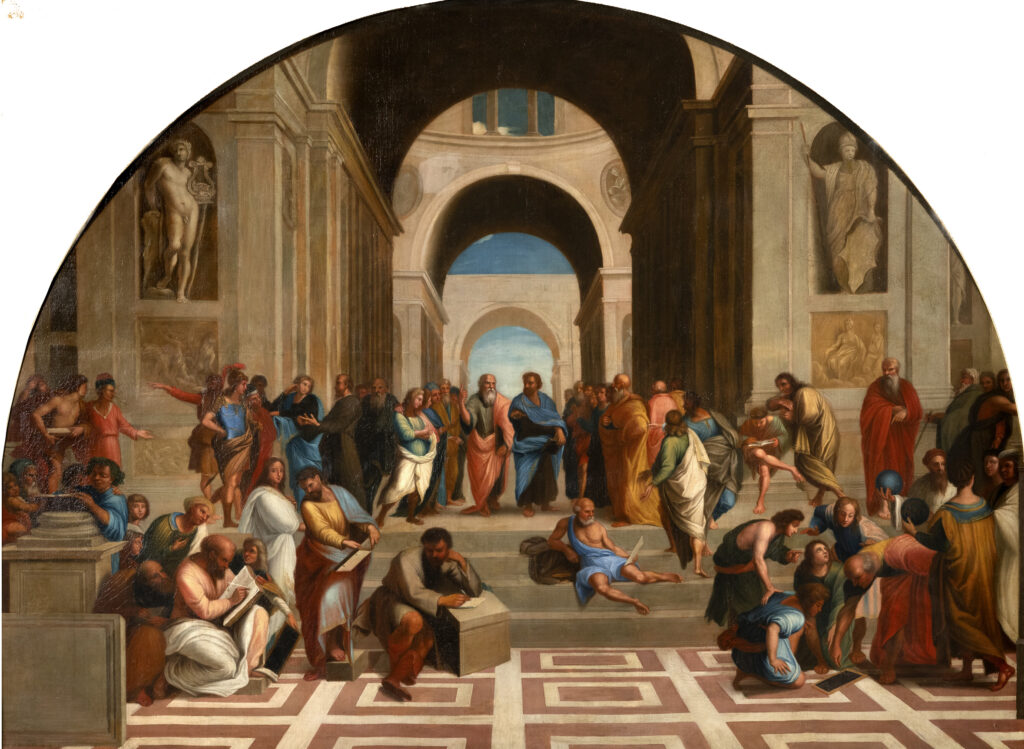
The canvas presented here reproduces, with more vibrant colors, Raphael’s School of Athens (1509–1510), the fresco in the Stanza della Segnatura in the Apostolic Palace. The room, conceived according to a program dedicated to humanistic culture (theology, philosophy, poetry, and jurisprudence), was probably intended as the library of Pope Julius II but soon came to house the tribunal of the Signatura Gratiae et Iustitiae.
The composition, set within a grand Renaissance architectural framework inspired by Bramante, brings together fifty-eight philosophers and mathematicians of antiquity. At the center stand Plato, holding the Timaeus, and Aristotle, holding the Ethics. In the foreground appear Pythagoras writing a book, Euclid demonstrating geometric concepts, and Zoroaster and Ptolemy with their globes; at the far right Raphael’s self-portrait can be recognized. The figure of Heraclitus, bearing the features of Michelangelo, occupies the center of the scene.
In the niches on either side of the staircase stand two statues inspired by classical models: Apollo on the left, with a lyre, and Minerva on the right, with helmet, spear, and a shield adorned with the head of Medusa. The enamel-like colors and direct light enliven the canvas, giving it a modern character while maintaining substantial adherence to Raphael’s original.