


Bartolomeo Neroni known as “Il Riccio”, circle of
(Siena, 1505/1510 ca. – 1571)
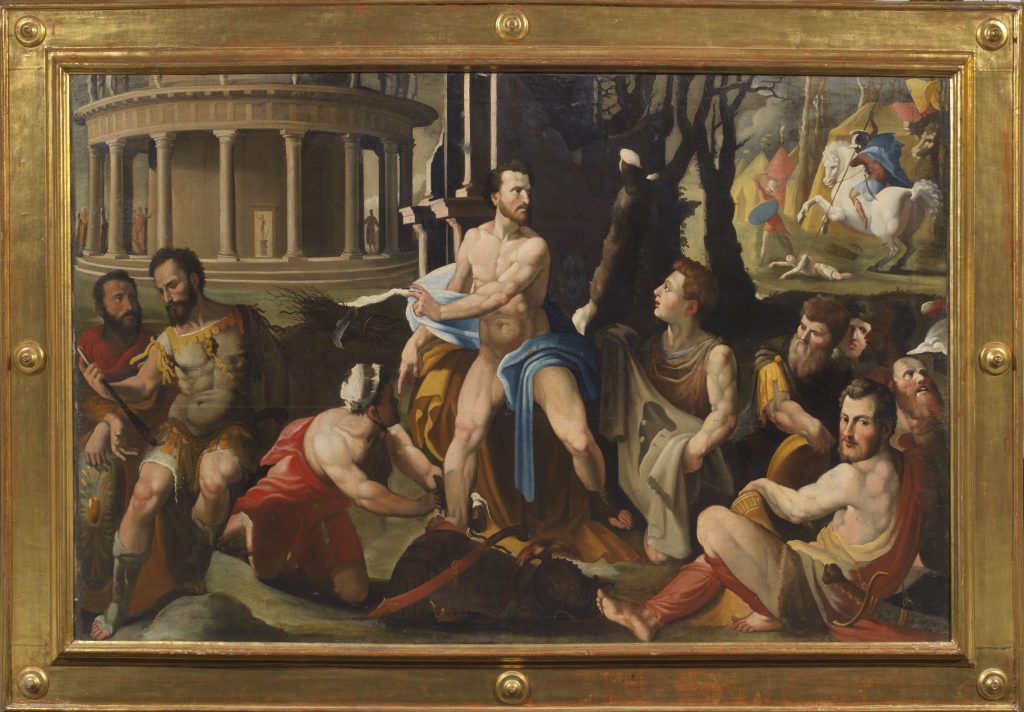
Sacrifice of Codrus
oil on canvas, cm 126×194
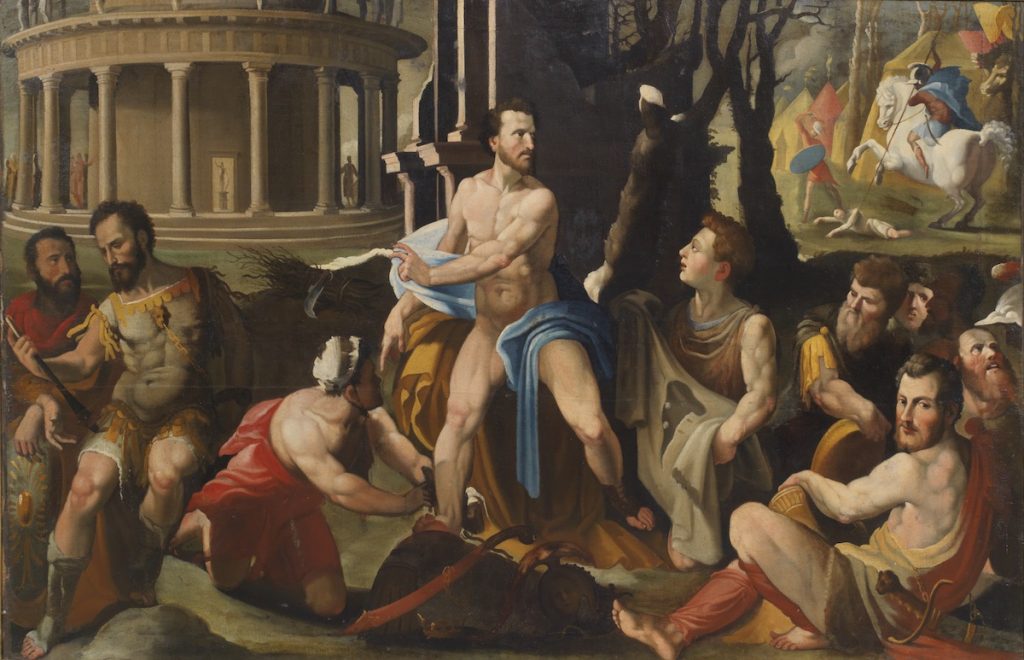
As reconstructed by Emilio Negro, who first undertook a careful analysis of the painting, the work “depicts an episode from ancient history recorded in Factorum et dictorum memorabilium libri IX (5, 6, ext. 1), the anthology composed of brief narratives presented as examples of virtuous or reprehensible conduct drawn from the lives of famous figures”, written by Valerius Maximus. The story concerns Codrun, the Athenian monarch of the 8th century BC who, during a siege, sacrificed his life for the city, which according to a prophecy would not be conquered if the king were killed by the enemy. In order to prevent his opponents – aware of the prophecy – rom sparing him, Codrus “abandoned his royal garments and disguised as a common soldier”, met his death in battle, thus saving Athens. The scene is represented on the canvas in three episodes: from left to right we see “the stoic monarch with sceptre and royal attire, then stripped of everything, and finally lying dead on the ground, killed by his enemies”, culminating in the striking upper-right corner with the rearing horse. From a stylistic point of view, as Negro observes, the work is a faithful quotation of the fresco of the same subject by the Sienese painter Domenico Beccafum between 1529 and 1535 on the walls of the Sala del Concistoro in the Palazzo Pubblico in Siena. Whilst Negro assigns the painting to an anonymous “skilled painter of imaginative pictorial manner”, active within “that sophisticated pictorial milieu in which inventive painters such as Bartolomeo di David and Bartolomeo Neroni, known as Il Ricco”, both pupils of Beccafumi, “were working”, a more precise attribution to Riccio has been proposed recently by the scholar Pietro Torriti. Torriti’s conclusion is based on stylistic comparisons with secure works by Neroni, in particular with the faces of certain figures: for example, the figure of Saint Francis in the “Coronation of the Virgin” (Pinacoteca Nazionale, Siena) and – as suggested here – also with the face of the Christ Child in the “Madonna and Child with Saint John the Baptist and Saint Catherine of Siena” in the Museo Diocesano of Palazzo Borgia in Pienza. To this may be added Riccio’s own artistic “practice”, which often led him to reproduce motifs by Domenico Beccafumi, including the latter’s original fresco, probably at close distance.
Publications:
“I volti della storia – Ritratti di uomini celebri a Roma dall’Impero al Neoclassicismo”, edited by Francesco Petrucci, De Luca Editori d’Arte, Rome, 2004, n. 4, pp. 76-77.