


MATTEO STOM
? 1643-Verona, 1702
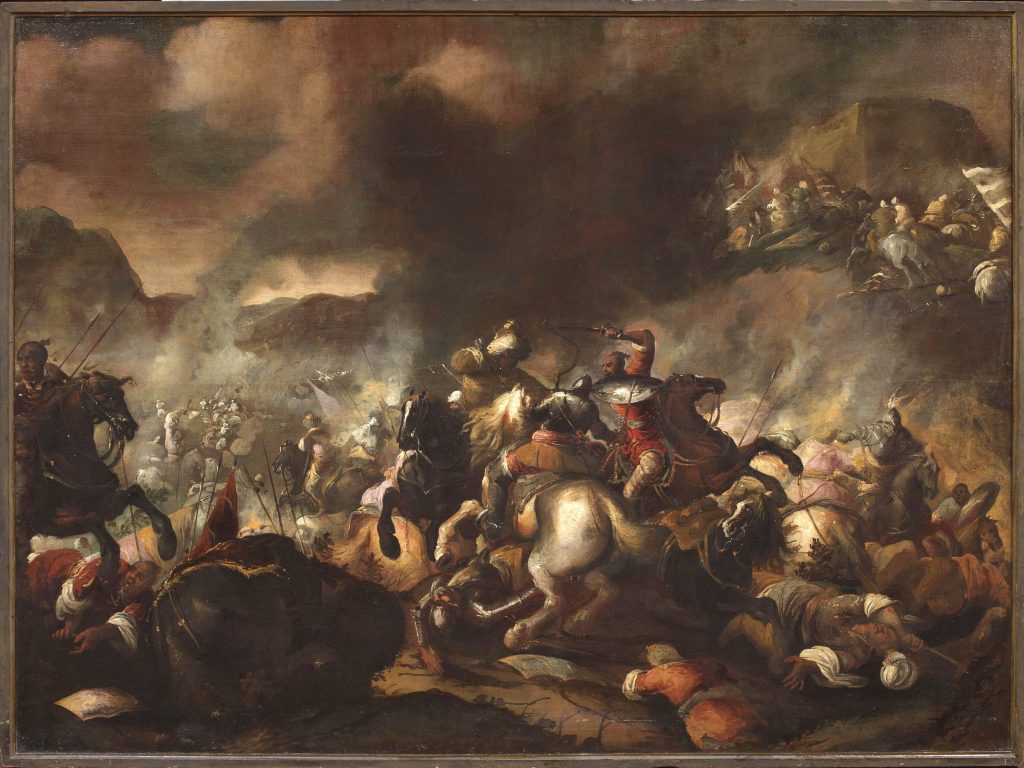
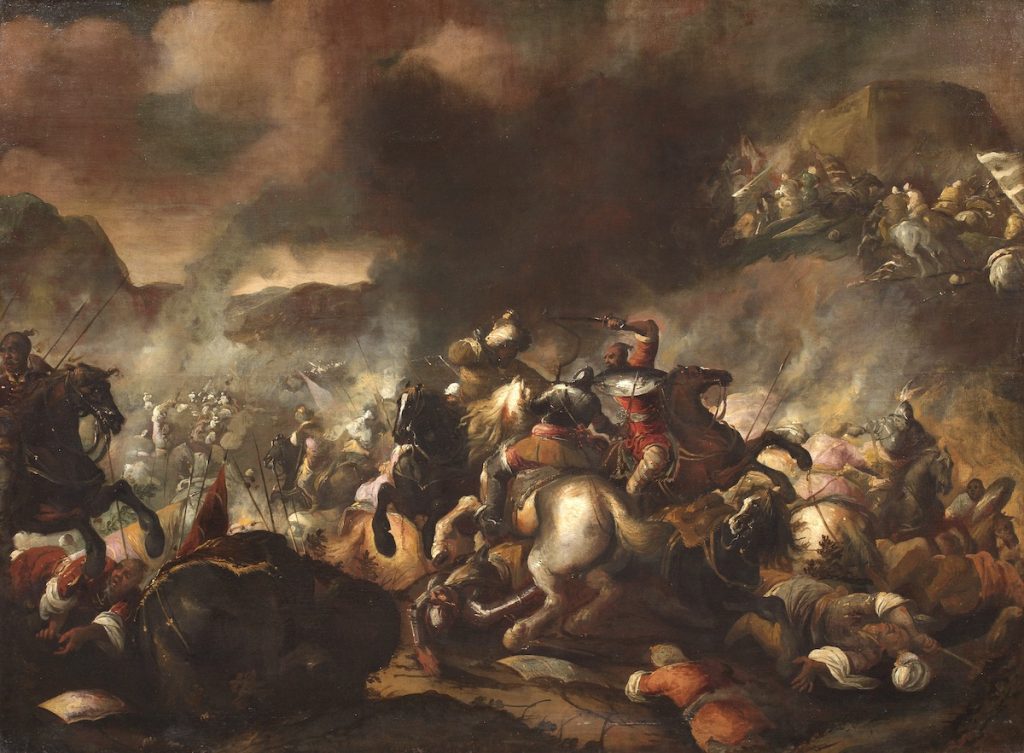
Battle between Christian and Turk cavalries
oil on canvas, cm 148×200
This evocative and dynamic “Battle between Christian and Turkish Cavalry” takes place at dusk in a valley. From its center rise dense clouds of dust—lifted by the heated clashes of the combatants—that ascend until they merge with the clouds in the sky. The fighting extends from the foreground toward the distance, spreading also across the slope on the right and beneath the bastions of a fortification, the probable direct objective of this grand military event.
The viewer’s attention is deliberately focused on the clash unfolding at the center, where a Christian warrior seen from behind—wearing helmet and armor and mounted on a white steed—confronts two opponents: one wearing a turban and the other bare-faced in a red jacket. Nearby, a knight of the European army has just been thrown from his horse, along with two other Turks who now lie lifeless on the ground, where abandoned weapons are scattered.
This principal scene is introduced on the left by two striking and powerful foreshortenings of two black horses: one seen from the rear, beside a dismounted Turk with a shaved skull and a queue, similar to his companion who remains mounted on a steed, shown in half profile.
The overall invention of this expansive battle scene—rendered with brilliant and vivid painterliness and with a concise representational synthesis—the presence of certain distinctive figure types, together with a flickering luminosity that, alternating with bright patches of color, creates a unified cohesion within the dynamic articulation of the entire composition, allow us to attribute the work with reliable certainty to its author. He is Matteo Stom (? 1643 – Verona 1702), a highly skilled specialist in this iconographic genre, who established himself in the Veneto and played an important role in the diffusion of this type of subject in its modern form, acting as a bridge with the specific Emilian artistic culture of Brescianino and Spolverini. Unfortunately, little documentary evidence survives concerning his activity, which presumably preceded that of Antonio Calza by a short time. Stom shares with Calza an affinity of style and a vivid chromatic vitality, often pushed by both painters to the limits of virtuosity.
The presence of a “Night Battle” by Stom—of which two other noteworthy versions with different variants have reappeared—in the Medici collections, already published by M. Chiarini in the catalogue (Centro Di ed., Florence 1981, no. 31) of the exhibition Battaglie held at Palazzo Pitti, suggests the hypothesis that Stom may have come into contact with the Tuscan cultural milieu of the second half of the seventeenth century. In that case, he would undoubtedly have been able to benefit from direct knowledge of works by Pandolfo Reschi, one of the most original and accomplished battle painters, active shortly after the rise of Jacques Courtois as the undisputed leading master of the genre at the European level.