


NICCOLÒ CODAZZI
Naples, 1642 – Genoa, 1693
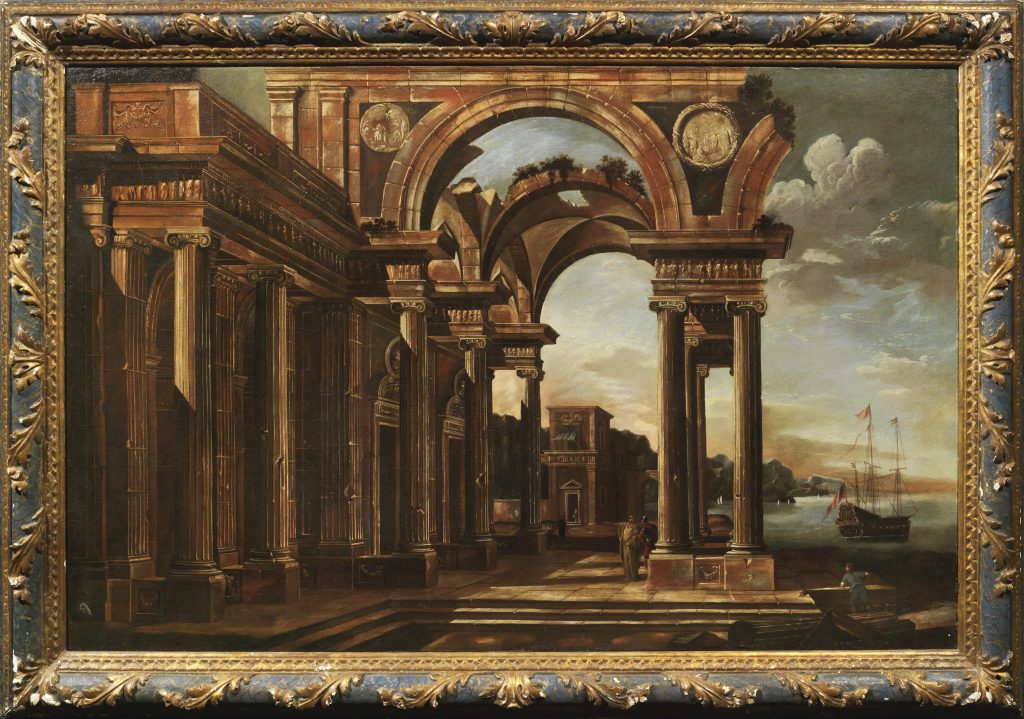
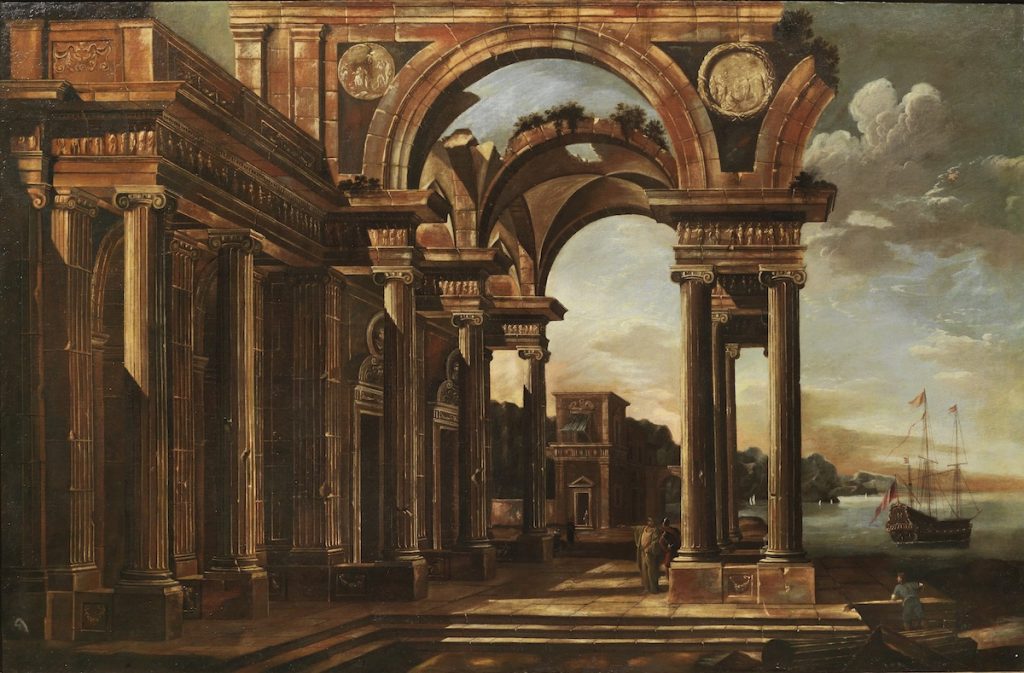
Architectural capriccio with marina
oil on canvas, cm 120×190
This imposing architectural capriccio presents a striking perspective of classical ruins, partially in decay, arranged along a port quay and overlooking a marine inlet, where a large vessel can be glimpsed at anchor. The scene, structured through loggias, arcades, and overlapping architectural elements, belongs to the tradition established by Viviano Codazzi (c. 1604–1670), the leading pioneer of the genre.
In his study of the present work, Giancarlo Sestieri attributed it to Niccolò Codazzi (1648–1693), Viviano’s son and a specialist in views with classical architecture. Little is known about his biography: the only secure points are his stay in Paris (1681–1682) and his final period of activity in Genoa, where he collaborated with local artists such as Gregorio de Ferrari and the Piola family.
In this painting, Niccolò demonstrates a close adherence to his father’s models, also evident when compared with analogous maritime capricci by Viviano. The freshness of the composition – featuring Ionic columns, arcaded loggias, and partially ruined structures – suggests an early date, “shortly before or just after the death of his father,” leaving open the possibility of a paternal invention.
While the solidity of the perspectival construction reflects Viviano’s practice, the softer palette and more nuanced chiaroscuro passages point convincingly to Niccolò’s hand, here still strongly indebted to his father’s teaching. The work thus occupies a significant place within the oeuvre of the younger Codazzi, in the context of Roman architectural capriccio alongside artists such as Salucci, Gagliardi, and above all Ghisolfi, with whom stylistic affinities can at times lead to attributional uncertainties.