


MASTER OF THE GREENVILLE TONDO
Umbria, active in the late 15th, early 16th century
Madonna with Child and Angels
dated: 1500 – 1505 ca.
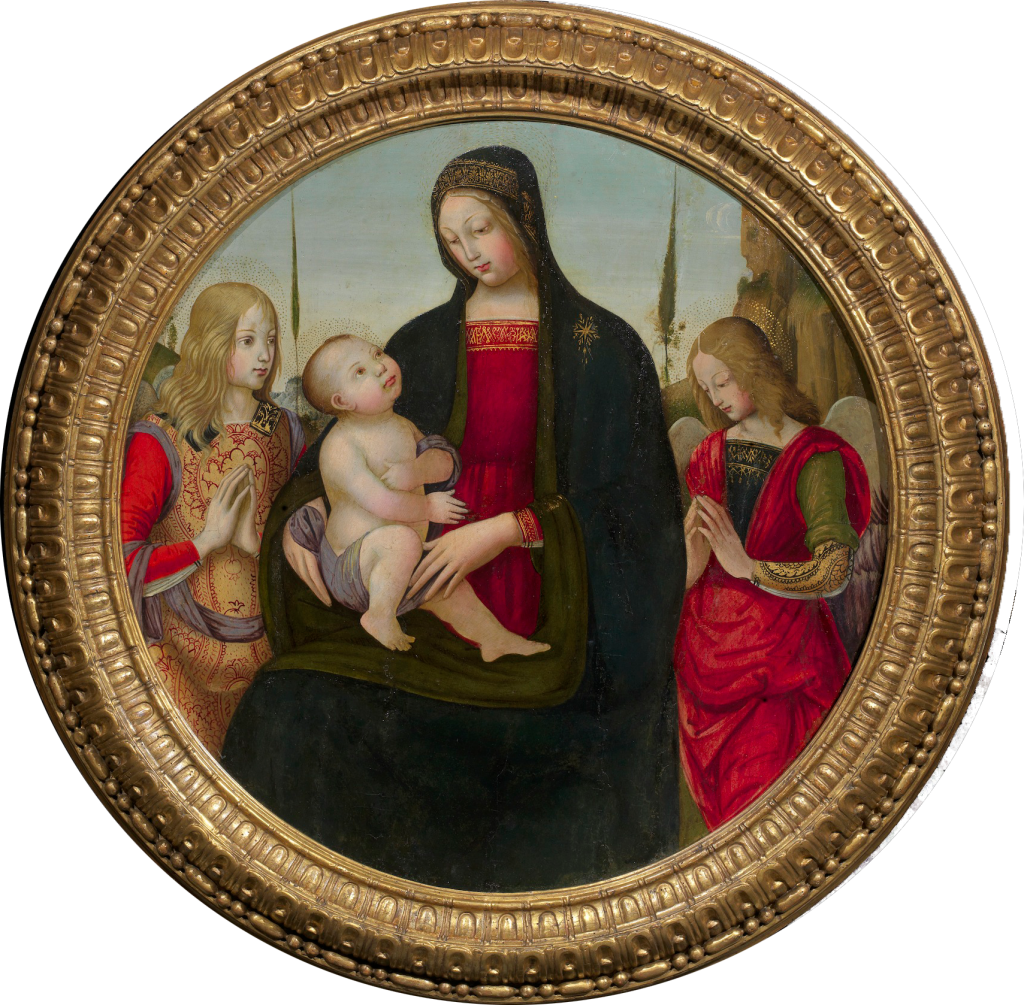
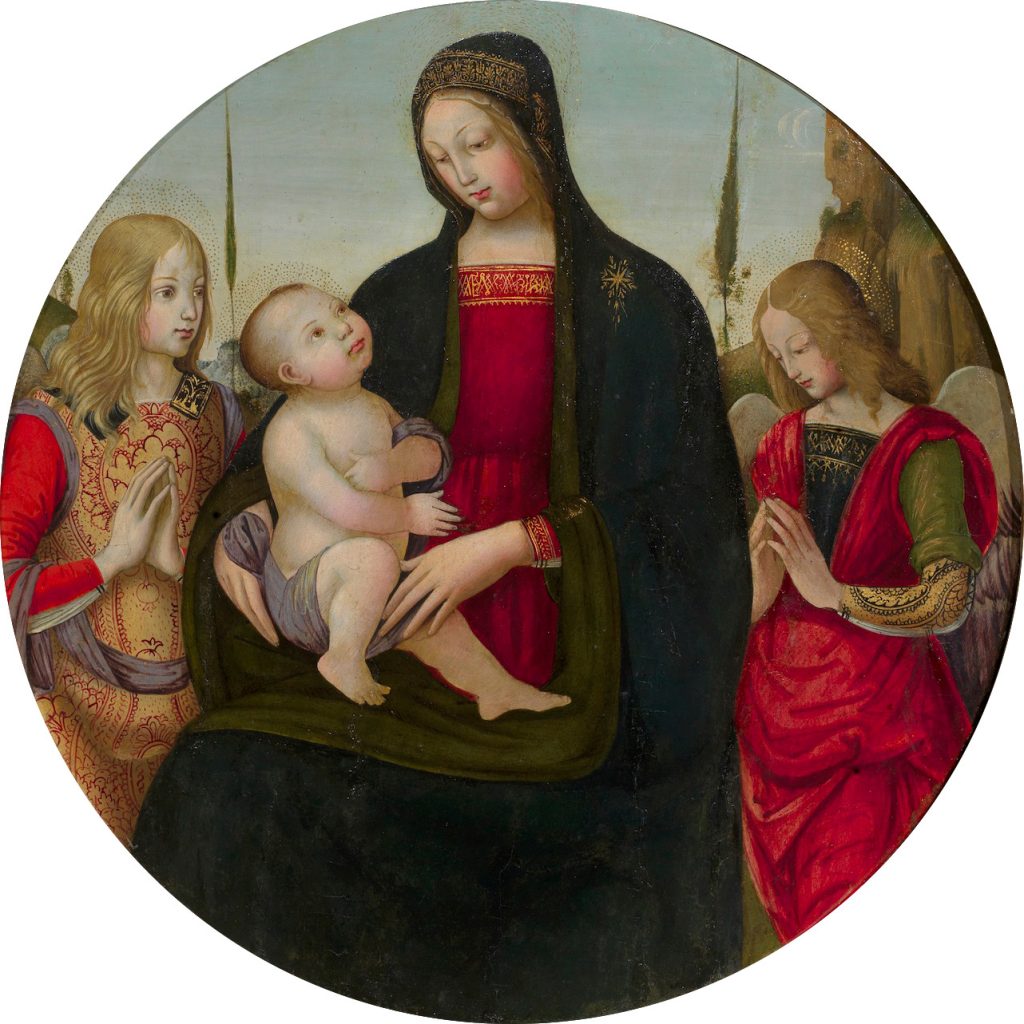
The charming tondo depicts the Virgin and Child with two angels, standing out against a sunlit landscape in which rocky wings appear to the right, while two tall trees convey the luxuriance of the vegetation. The painting is a characteristic work of the still-anonymous artistic personality who, following the studies of Federico Zeri and Everett Fahy, has conventionally been designated the Master of the Greenville Tondo, after a comparable work preserved at Bob Jones University in Greenville, United States. Although compositional affinities with the Florentine production of Pietro Perugino have led most scholars to classify this anonymous artist among the Tuscan followers of the Umbrian master, certain recent attributions have suggested a different critical interpretation. Indeed, upon examining the Saint Sebastian at Princeton, traditionally regarded as a cornerstone within the catalogue of the Master of the Greenville Tondo, significant stylistic analogies emerge with the work of Evangelista di Pian di Meleto, collaborator of Raphael on the Baronci Altarpiece, painted between 1500 and 1501 for the church of Sant’Agostino in Città di Castello and now housed at the Museo di Capodimonte. Such affinities therefore allow the hypothesis to be advanced that the Master of the Greenville Tondo may in fact be identified with Evangelista himself. Once the Umbrian or Peruginesque component – which in the works of the Greenville Master appears comparatively superficial – has been reconsidered, a further interpretative line may be proposed in relation to the oeuvre of the Lucchese Master of Stratonice, namely Michele Ciampanti, particularly with the panel depicting the Stories of Orpheus in a private collection. Indeed, the style of this painter, reflecting the artistic world of Filippino Lippi and his Lucchese followers, especially Vincenzo Frediani, is clearly discernible in the present tondo, above all in the faces of the angels and in the richness of the brocade-decorated garments. The monumentality of the Virgin and the pyramidal arrangement of the figures are characteristic features of the painter’s style, as is the lustrous, almost metallic treatment of the flesh tones. Taken together, these elements make it possible to place the present painting in the final years of the 16th century.