

HOLY WATER FONT
carved stone
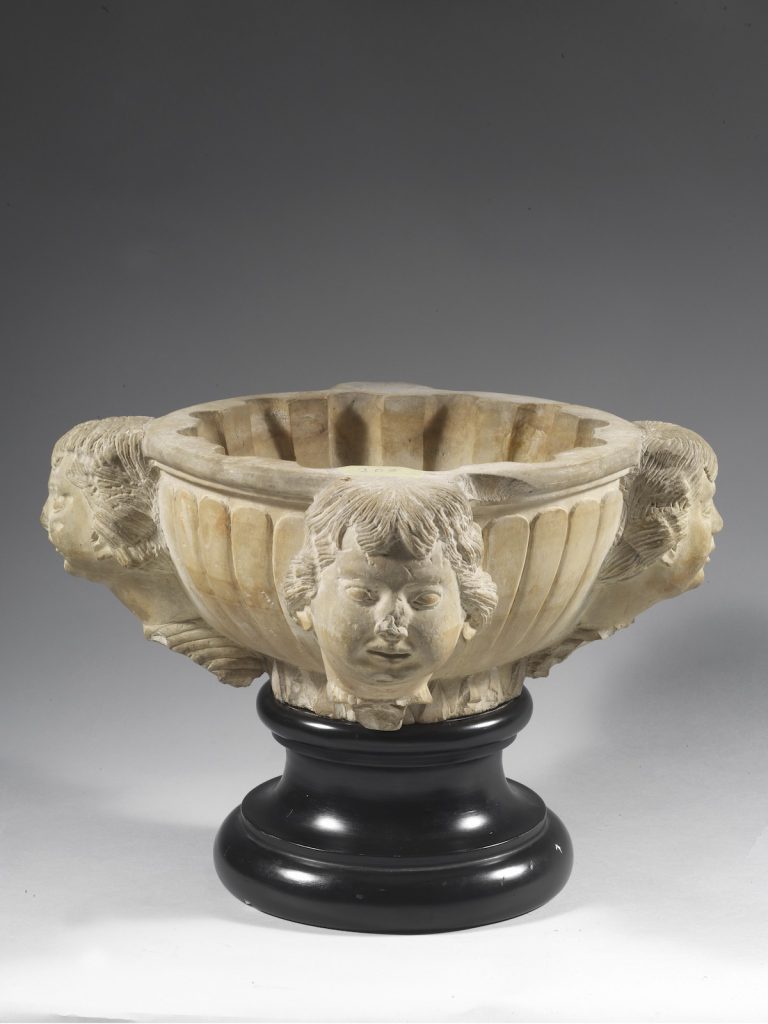
Refined carved stone holy water stoup, formed as a hemispherical basin with an internal cavity intended to contain holy water. The exterior of the bowl is decorated with regular gadrooning that rhythmically articulates the surface up to the upper rim, which is slightly moulded and projecting.
Around the perimeter of the basin are four evenly spaced putto heads. The infant faces, carved in high relief, display full and soft features framed by lively, voluminous hair. The heads emerge plastically from the surface of the bowl, contributing to the dynamism of the composition while simultaneously serving a decorative and structural function.
The lower part of the basin rests on a short moulded base; in its current display the piece stands on a modern pedestal.
The iconography of the putti and the gadrooned decoration refer to ornamental models of classical derivation widely employed in Italian Renaissance art and in later decorative productions, particularly within the field of carved stone liturgical furnishings.
Central Italy, end of the 15th century
cm 33 height, cm 40 diameter