

VENUS CALLIPIGYGIA
alabaster
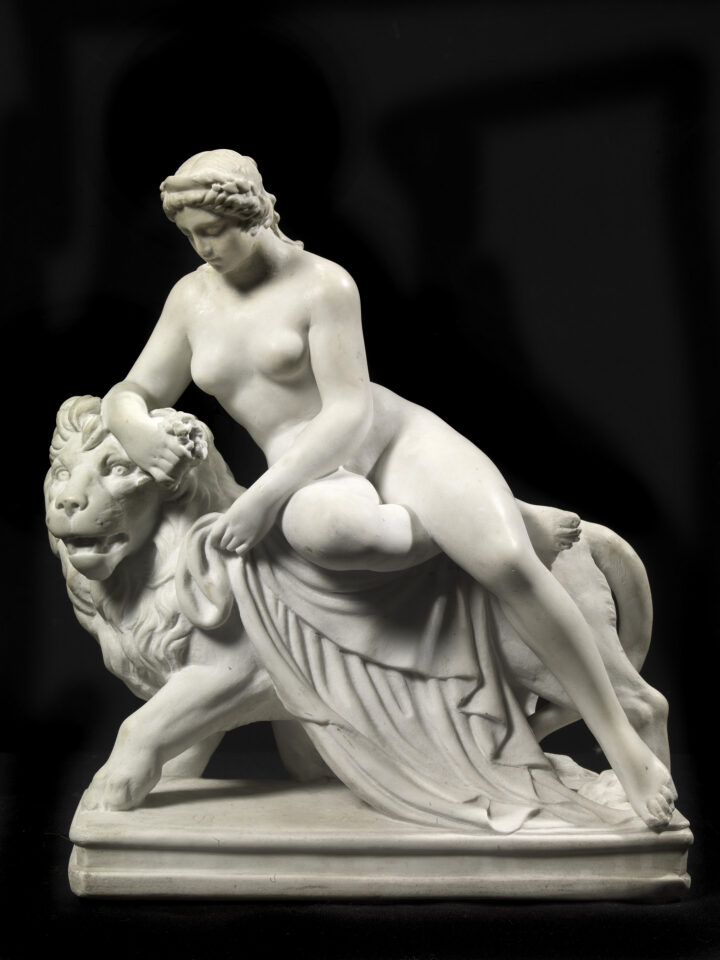
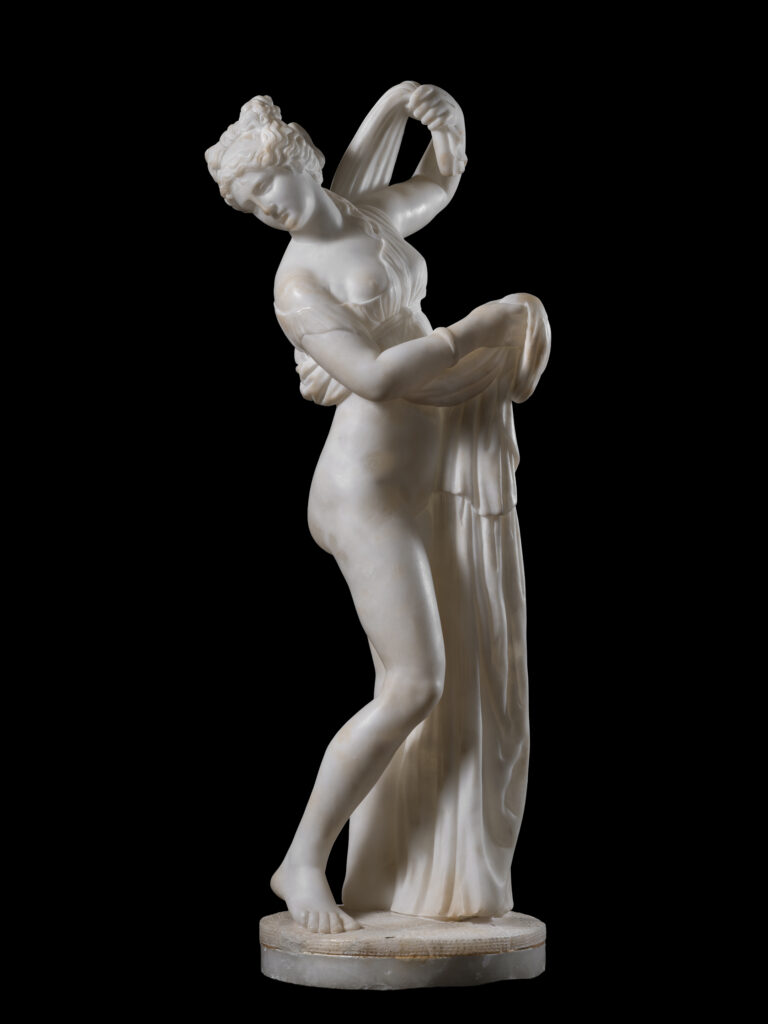
The “Venus Callipyge” is a Roman sculpture derived from a Greek original dating to the 3rd century BC, unanimously regarded as one of the highest expressions of sensuality in ancient art. Its name, from the Greek kalòs and pygḗ (“with beautiful buttocks”), explicitly refers to the focal point of the composition: the harmonious and refined celebration of the beauty of the female body.
The figure represents Venus, goddess of love and beauty, captured in a pose that is at once elegant and playful. The stance is dynamic and sinuous: the torso gently twists, one leg bends while the other bears the weight, creating a fluid balance of lines and volumes. With her arm raised, the goddess lifts a fold of her chiton – the finely pleated Ionic tunic – allowing the body to emerge and emphasizing its forms. The gesture, only seemingly spontaneous, is in fact carefully composed to establish a subtle dialogue with the viewer, blending modesty and seduction in an image of extraordinary grace.
The drapery, rendered with astonishing skill, clings to the body while at the same time falling naturally, creating a refined contrast between the smoothness of the skin and the soft fluidity of the fabric. Such attention to surface treatment and the tactile quality of the marble reveals the influence of Hellenistic art, characterized by a heightened search for expressive intensity.
Discovered near the Domus Aurea without its head and other parts, the sculpture was acquired in 1594 by the Farnese family and subsequently restored, thus entering their prestigious collection. During the 18th century, under the Bourbons, it was transferred to Naples, where it underwent further inteventions, including those by Carlo Albacini, before being placed in the National Archaeological Museum. Its fame was such that it attracted attention even during the Napoleonic spoliations, confirming its universally recognized value.
As a whole, our alabaster sculpture stands as a refined reinterpretation of the Roman original, capable of conveying its formal elegance and sensual appeal through careful attention to detail and a sophisticated rendering of surfaces, in perfect harmony with the ideal of graceful and seductive beauty characteristic of the classical tradition.
Neoclassical sculptor, early 19th century
cm. 40h