


BARTOLOMEO BETTERA
Bergamo, 1639 – doc. until 1699
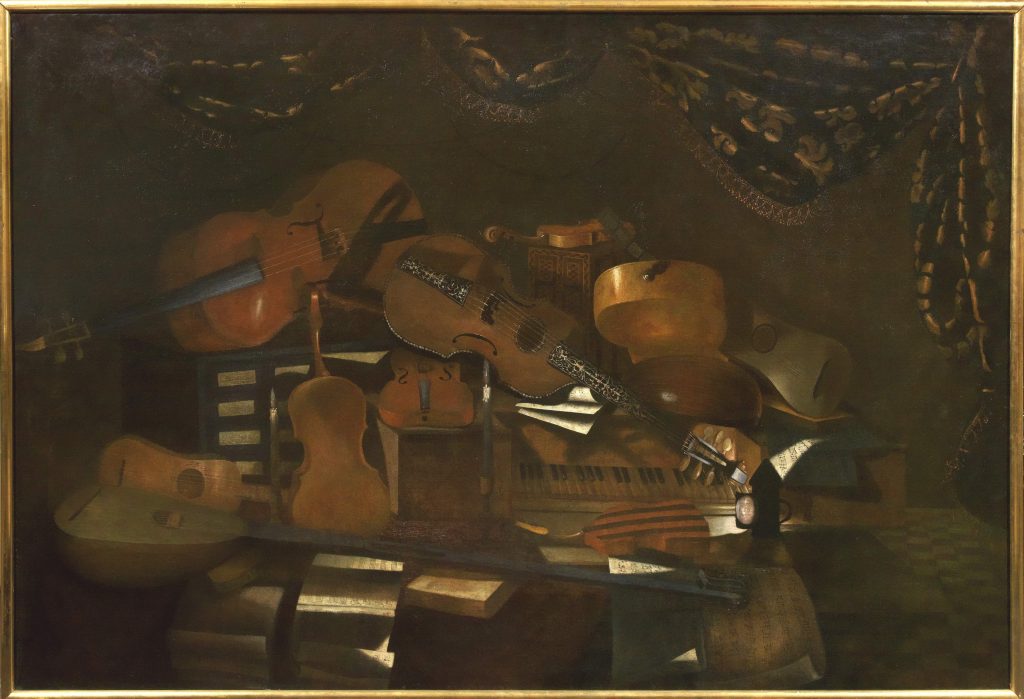
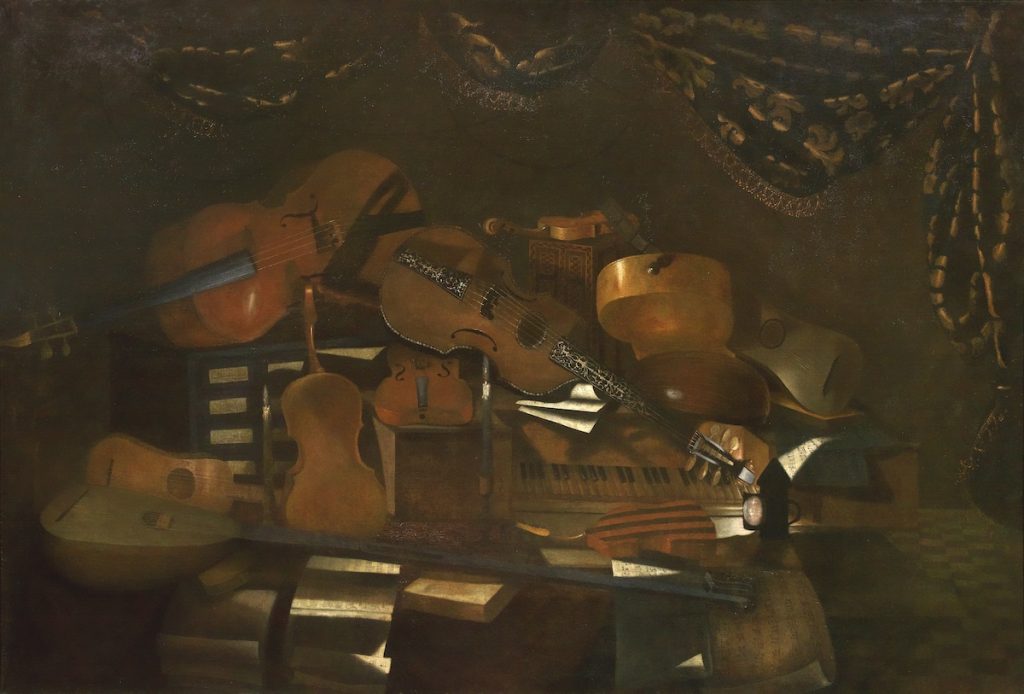
Still life with musical instruments
oil on canvas, cm 162×244
As Lanfranco Ravelli emphasizes in his study devoted to the painting, this still life is a valuable formerly unknown trace of the mature phase of Bartolomeo Bettera’s career, who was the greatest specialist in still-life compositions with musical instruments after his fellow Bergamasque Evaristo Baschenis (1617-1677). The latter was certainly studied by Bettera, who repeatedly demonstrates his knowledge of a dependence upon the Bergamasque master. However, as the scholar Alberto Cottino argued in the past, Bettera “was a real artist, endowed with his own figurative language”, revealing a culture “which appears more modern and eclectic than the more traditional and Lombard one” of Baschenis (in “Bartolomeo Bettera. La sonata Barocca”, catalogue of the exhibition curated by A. Cottino, Bergamo, 2008, p. 6).
In our still life, Bettera depicted an extraordinary array of stringed instruments, a cabinet, a harpsichord, and musical scores, framed by a sumptuous drapery and a rare instrument, a wing-shaped viola, which appears in many other paintings by the Bergamasque painter. Particularly impressive is the abundance of objects represented, piled up and balanced precariously, which, according to Ravelli, represent “the unsettling metaphor of vanitas, the inevitable dissolution of earthly seductions into nothingness” a concept undoubtedly reinforced by the presence of two lit candles and a lantern – this a quite uncommon presence in Bettera’s work. Remarkable for its unusual, indeed monumental dimensions, the canvas was likely painted, as Ravelli suggests, in the final phase of the artist’s life, about which unfortunately very little biographical information survives. It likely dates from after his encounter with Roman painting, an experience that prompted Bettera toward a “grand manner” of which this work “constitutes a summa”.
PUBLICATIONS:
“Due aggiunte al catalogo di Bartolomeo Bettera” in “La rivista di Bergamo”, edited by Lanfranco Ravelli, Grafica e Arte Editore, Bergamo, 2016, no. 88, pp. 64-67.