

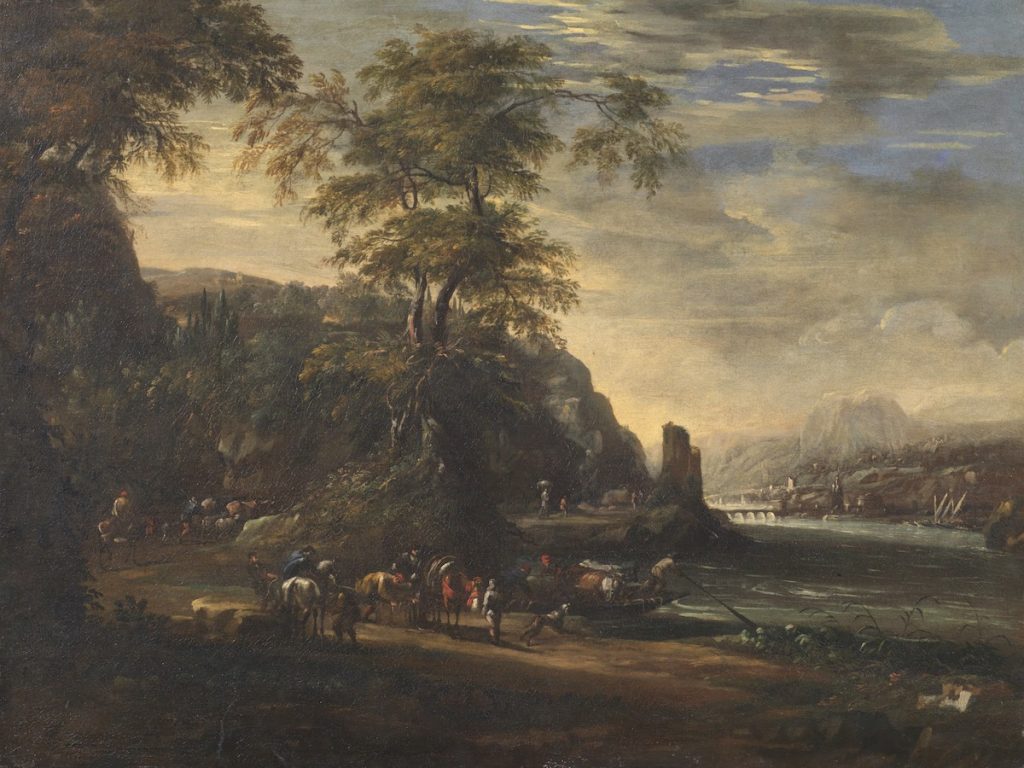
JOHANN ANTON EISMANN
Salzburg, 1604 – Venice, 1698
Landscape
oil on canvas, cm 101×134,7
The painting has been assigned by Dario Succi to the Salzburg-born master Johann Anton Eismann, who, as the scholar notes, “played a primary role in the emergence and dissemination of landscape painting in Venice”. After relocating to the lagoon city around 1660, the German painter is recorded as a member of the local Fraglia (guild) of painters from 1787 to 1700 – evidence that contradicts the traditionally accepted date of his death – specializing in landscapes and battle scenes which, in their combination of wild nature and Roman ruins, reveal the influence of Salvator Rosa. These compositions are further enlivened by the characteristic repertoire of animated ‘macchiette’ (pictorial types), which, according to Succi, “antedates the motifs of Luca Carlevarijs”.
Particularly noteworthy is the atmospheric rendering of the sky in our painting, a feature which, as Succi highlights, the scholar Eduard Safarik had already identified years ago as one of the most remarkable qualities of the paintings by the German artist.
As for the dating, Succi proposes the ninth decade of the 17th century “in view of the particular composition and the free brushstrokes”. This would place the work slightly earlier than the tradition of “landscape capricci that, towards the end of the 17th century, would bring fame to Luca Carlevarijs, the Friuli-born artist whose training was undoubtedly indebted to the example of Johann Anton Eismann”.