


Pietro Liberi, attributed to
Padua, 1605 – Venice, 1687
Jupiter and Io
oil on canvas, cm. 128,5×111
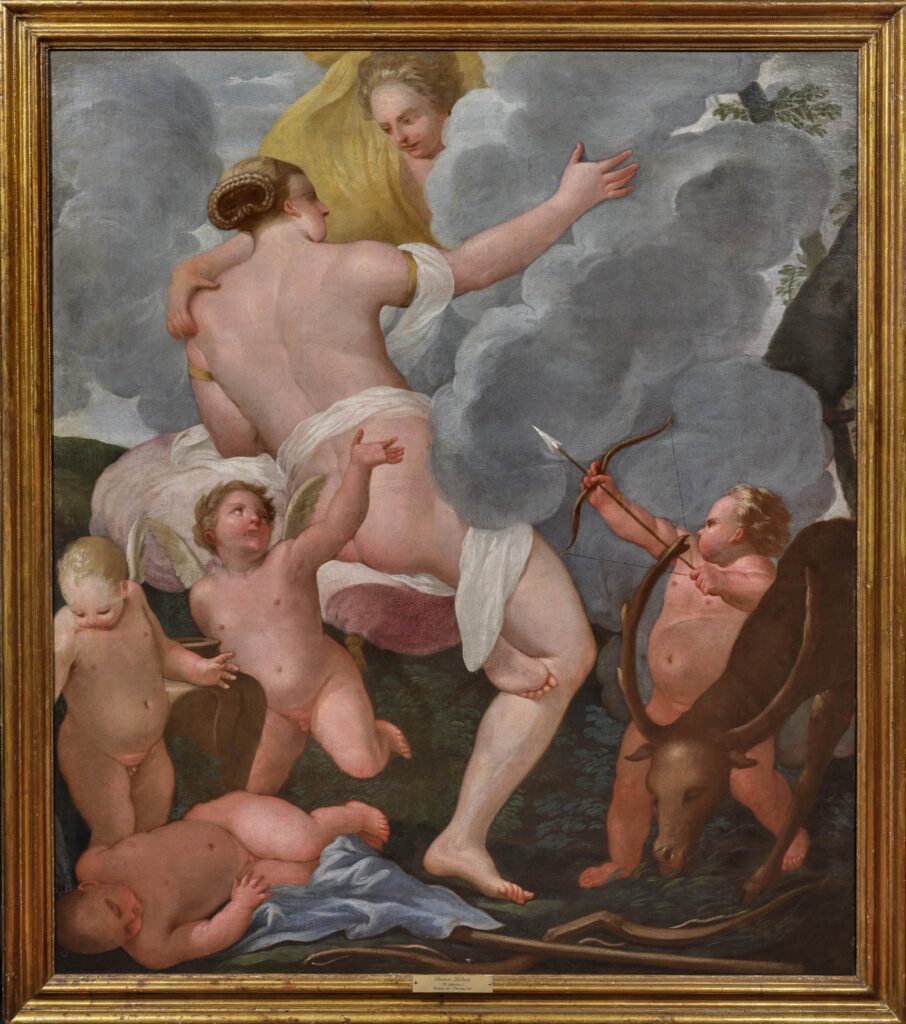
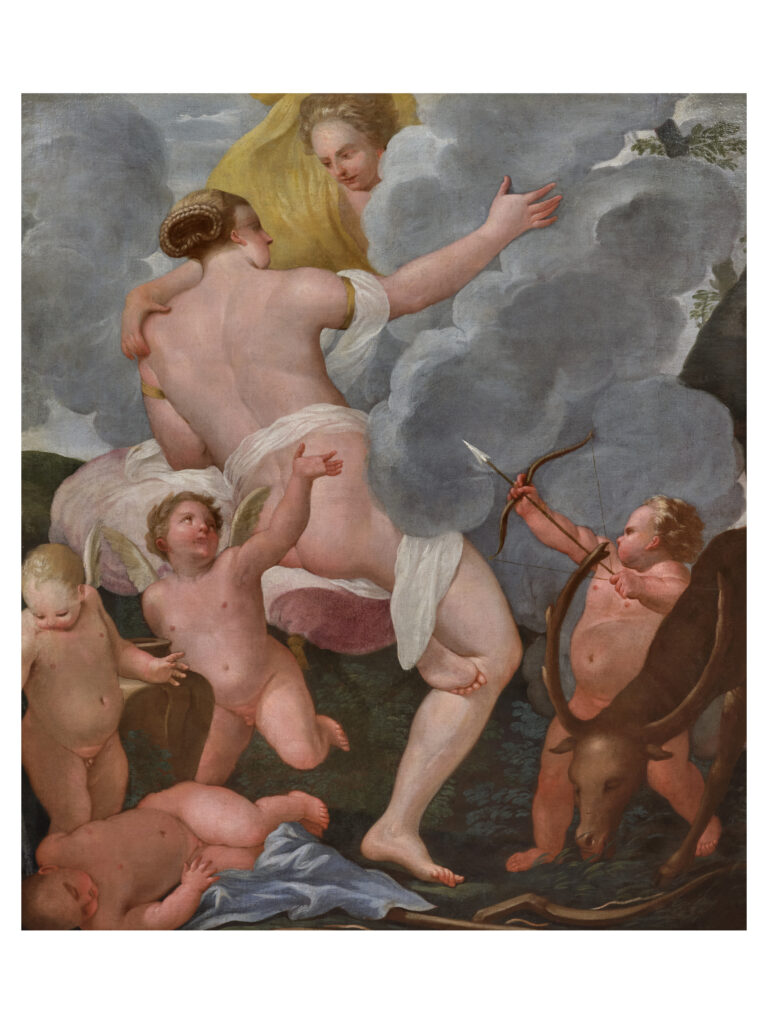
This painting, attributed to Pietro Liberi, depicts the famous myth of Jupiter and Io, drawn from Ovid’s Metamorphoses. The scene shows the nymph Io, wrapped in a light white drapery that leaves most of her body uncovered, in a dynamic and sensual pose: her body is turned backwards, while her gaze and the gesture of her arms rise upward, where Jupiter appears enveloped in clouds. The god, hidden from Juno’s sight, takes form among the vapors and extends his arms toward the young woman, embracing her in a gesture that unites the earthly and the divine.
Around them move several winged putti, minor yet essential protagonists in the symbolic construction of the work. Some observe the scene with lively gestures, others play, while one in particular, on the right, draws his bow with an arrow ready to strike, an evident reference to Cupid and the power of desire. The presence of these figures introduces a note of lightness while at the same time underlining the theme of love, typical of 17th-century mythological painting.
The style of Pietro Liberi, a painter known for his inclination toward libertine and mythological subjects, clearly emerges: the careful rendering of the female nude, smooth and luminous; the theatricality of the composition, conveyed through the movement of bodies and the density of the clouds; the use of chiaroscuro, contrasting the softness of flesh with the drama of the atmosphere. This approach situates him fully within the Baroque taste, where myth becomes an occasion to exalt the body and to intertwine eros and divinity.
The subject had illustrious precedents: most notably Correggio’s “Jupiter and Io” (Kunsthistorisches Museum, Vienna), painted in the previous century, where the god is rendered as an enveloping cloud that fuses with the body of the nymph in an intimate, almost whispered scene, charged with subtle and veiled eroticism. Compared to that Renaissance vision, Liberi instead accentuates spectacle and narrative tension, placing the figures in a more dynamic and choral context.
In the 17th century, painters such as Francesco Albani and Guido Reni often developed mythological scenes populated with cupids, characterized by a polished and idealized grace. In this canvas by Liberi, we find the same lightness in the use of putti, but enriched with atmospheric pathos and a compositional freedom that brings him closer to Baroque experiments such as those of Pietro da Cortona, a master in depicting turbulent skies and figures wrapped in clouds and vapors.
The result is a work that unites sensuality and theatricality, Renaissance memory and Baroque invention, confirming Pietro Liberi’s ability to move freely among different models and reinterpret them with a highly personal and expressive touch.