


MARCO LIBERI
Venice, 1644 – Doc. until 1696
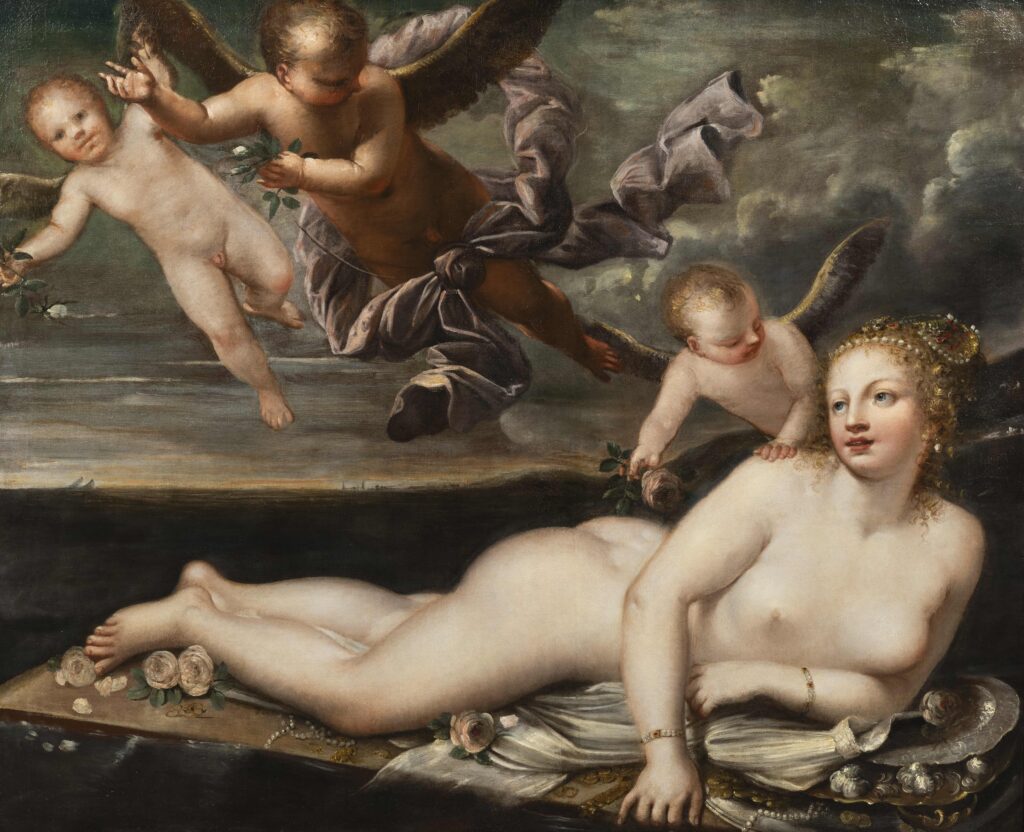
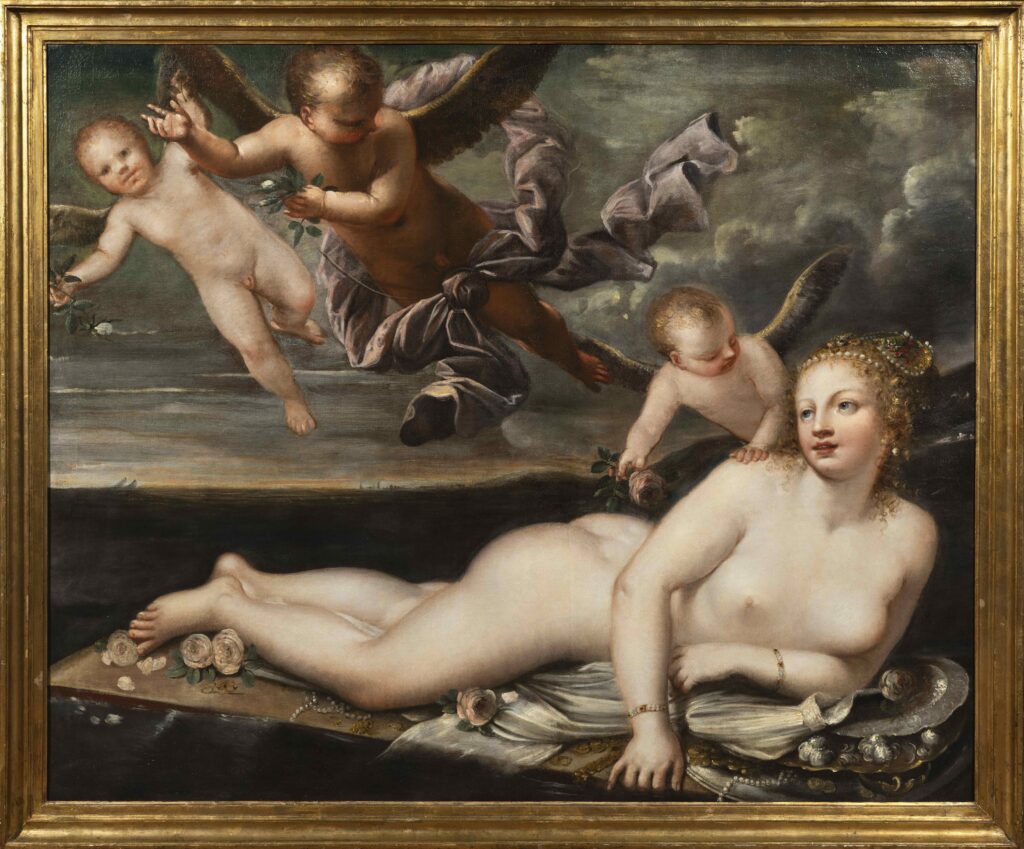
Venus and cupids
oil on canvas, cm. 136×164
The painting belongs fully within the figurative culture of 17th-century Venice, an artistic context in which allegorical and symbolic dimensions are closely intertwined with the pursuit of visual pleasure and formal seduction. As Fabrizio Magani, author of a study on the painting, observes, “the protagonist is Venus, depicted as the embodiment of beauty, love and seduction, surrounded by cupids celebrating her power”. Their gesture of scattering roses thus acquires “an almost ritual significance”, suggesting a symbolic offering to the universal force of love. Alongside this is an equally significant dimension of luxury and wealth: the jewels, trays laden with precious objects and even a small bundle evoke, as the critic notes, “the connection between love, luxury and sensual pleasure”. The result is an ambivalent vision, characteristically Baroque, in which love appears at once seductive and perilous, capable of elevating yet also deceiving, of enriching while at the same time corrupting.
From a stylistic point of view, the work clearly betrays the close relationship between Marco Liberi and the example of his father, Pietro, though reinterpreted in a more measured direction: the latter’s “exuberant manner”, visible in drawings such as the Rape of Europa and Leda and the Swan in the Galleria Estense in Modena – which indeed display comparable compositional solutions, particularly in the treatment of the female nude and the dynamic construction of the group – “seems to bend towards a new purity of form”. This greater formal restraint is accompanied by more carefully balanced draughtsmanship and by a sensibility already attuned to the Classicising tendencies that, towards the close of the seventeenth century, also spread through Venice under the influence of Roman and Bolognese painting. A significant comparison can be suggested with the Venus with Cupid in the Kyiv Museum, a secure work by Marco Liberi, with which this painting shares both the arrangement of the female figure and the intimate interaction with the putti. Overall, the painting effectively conveys that 17th-century sensibility attracted to the grace of youth and the seduction of the body, yet equally aware of their fragility. It is precisely this tension between pleasure and transience, between formal elegance and moral allusion, that makes Marco Liberi’s work a significant example of Venetian Baroque figurative culture, poised between memory of the past and stylistic renewal.
The painting was formerly in the collection of the Hungarian-born American mathematician John von Neumann and his wife Mariette, to whom it had been given by her parents, Géza Kövesi and his wife from Budapest, on the occasion of her marriage to von Neumann in 1929.