


GIUSEPPE MANCINELLI
Naples, 1813 – Castrocielo, 1875
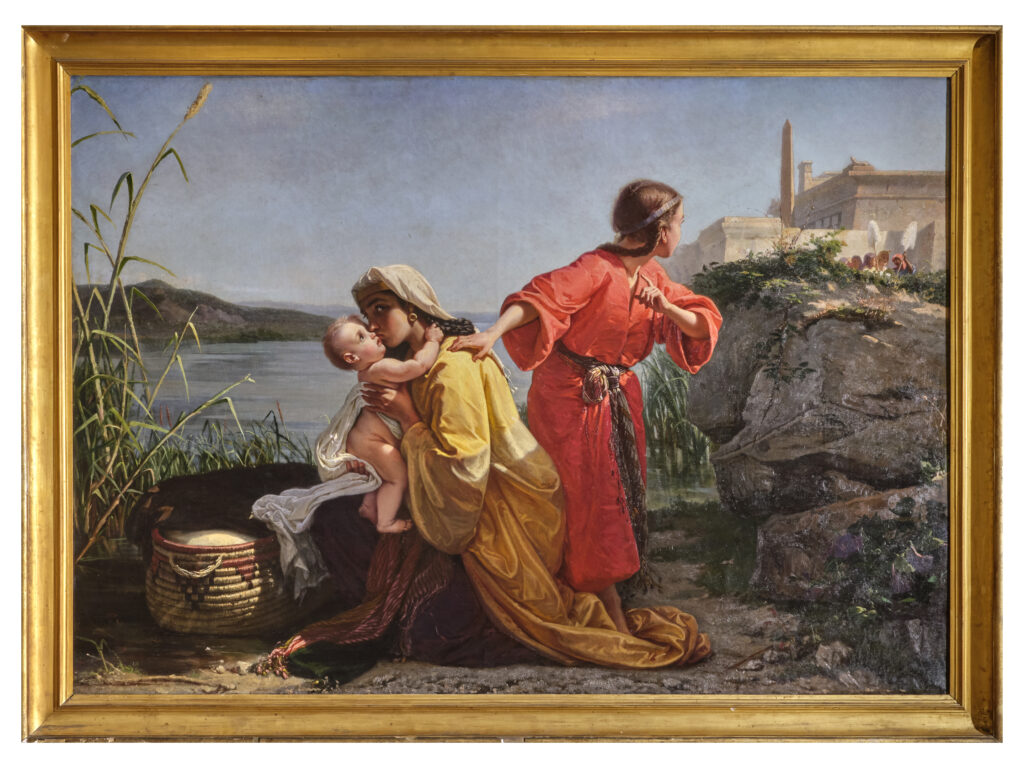
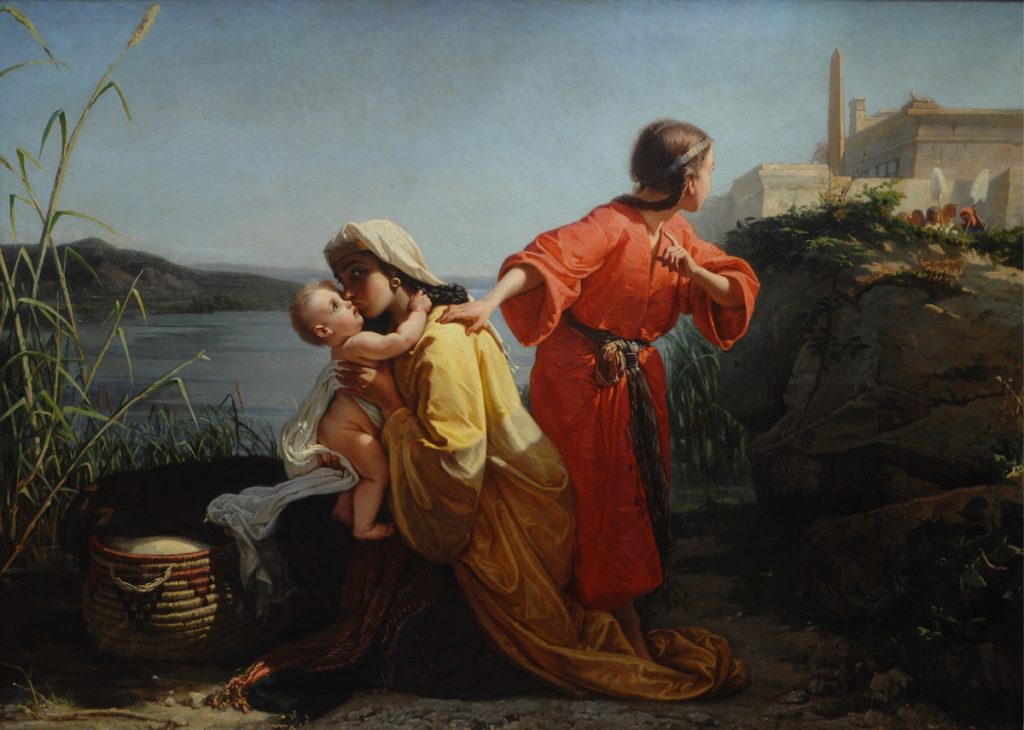
Moses abandoned by his mother
oil on canvas, cm 181×255
The painting depicts an episode from the biblical Book of Exodus, narrating the abandonment of the infant Moses in the waters of the Nile, a stratagem devised by his mother to save him from the persecution of the Pharaoh of Egypt (Ex. 2:1–3). The subject, rich in narrative intensity, is developed by the artist through a carefully balanced construction of figures and surrounding environment, combining emotional pathos with formal composure. The author of the work is Giuseppe Mancinelli, a Neapolitan painter who distinguished himself in religious and historical subjects, characterised by a vivid chromatic intensity derived from the lessons of Italian Purism and the Nazarenes, whom he encountered during his stay in Rome, an opportunity made possible by a scholarship from the Bourbon Kingdom. It was in Rome, under the guidance of Vincenzo Camuccini, that he refined his training, assimilating the Romantic culture of history painting, and thus contributing to the renewal of the Neapolitan artistic scene in the mid-19th century. From 1851 onwards, fortified by the success he had also achieved among aristocratic circles, Mancinelli was appointed to teach drawing at the Academy of Fine Arts in Naples, where he promoted a form of classicism informed by Purist ideals, combined with Romantic emotional power and a keen attention to reality, anticipating aspects of the emerging Verismo in painting. This stylistic trait is clearly evident in the present work, particularly in the attention devoted to the faces of Jochebed and Miriam, as well as the infant Moses, and in the thoughtful use of bright, luminous colours that ensured the critical success of Mancinelli’s painting in the following decades. An important testimony is provided by Cesare Dalbono, who, in a tribute published in the Albo Artistico Napoletano in 1853, recalled that the “Moses” had been exhibited at the Real Museo Borbonico in Naples in February 1851, a circumstance that allows the completion of the painting to be placed around that date. The work was later mentioned by Capogrossi Guarna in the artist’s obituary of 1875, where it is remembered as “the Moses abandoned by his mother, of most splendid colouring.” The painting fully reflects the 19th-century taste for exotic themes and historically reconstructed settings, widely diffused in the visual culture of the period and shared across artistic spheres. In Mancinelli’s work, the foreground figures, rendered with refined academic skill, display traits that suggest an idealised folklore rather than strict historical verisimilitude. In the background, which reveals an affinity with early 19th-century Neapolitan landscape painting, a temple and an obelisk are depicted with notable precision, suggesting careful study, likely mediated through the numerous engravings found in mid-century illustrated guides to Ancient Egypt.
The painting comes from the collection of Professor Fausto Nicolini (1879–1965), as attested by a label of the Royal Superintendence of the Galleries of Naples at the back of the painting, (“Deposit for protection from war risks, 1940, XVIII”, no. 031).
Pubblications:
“Intorno ad alcune opere di Belle Arti esposte nel Real Museo Borbonico nel febbraio del 1851”, curated by Cesare Dalbono, in “Albo Artistico Napoletano”, edited by Mariano Lombardi, Stamperia e Cartiere del Fibreno, Naples, 1853, pp. 38-39.
“La Madre di Mosè. Dipinto in tela di Giuseppe Mancinelli”, edited by R. Colucci, “Museo di Famiglia – Rivista Illustrata”, Vol. 5, no. 2, 9 January 1865, pp. 23-25 (Reproduced as a full-page lithograph at p. 26).
“Necrologia del Cav. Prof. Giuseppe Mancinelli”, “Il Buonarroti”, edited by Capogrossi Guarna, 1879, serie II, vol. X, vol. III, xvi, pp. 96-107.