


FRANÇOIS DE TROY, circle of
Toulouse, 1645 – Paris, 1730
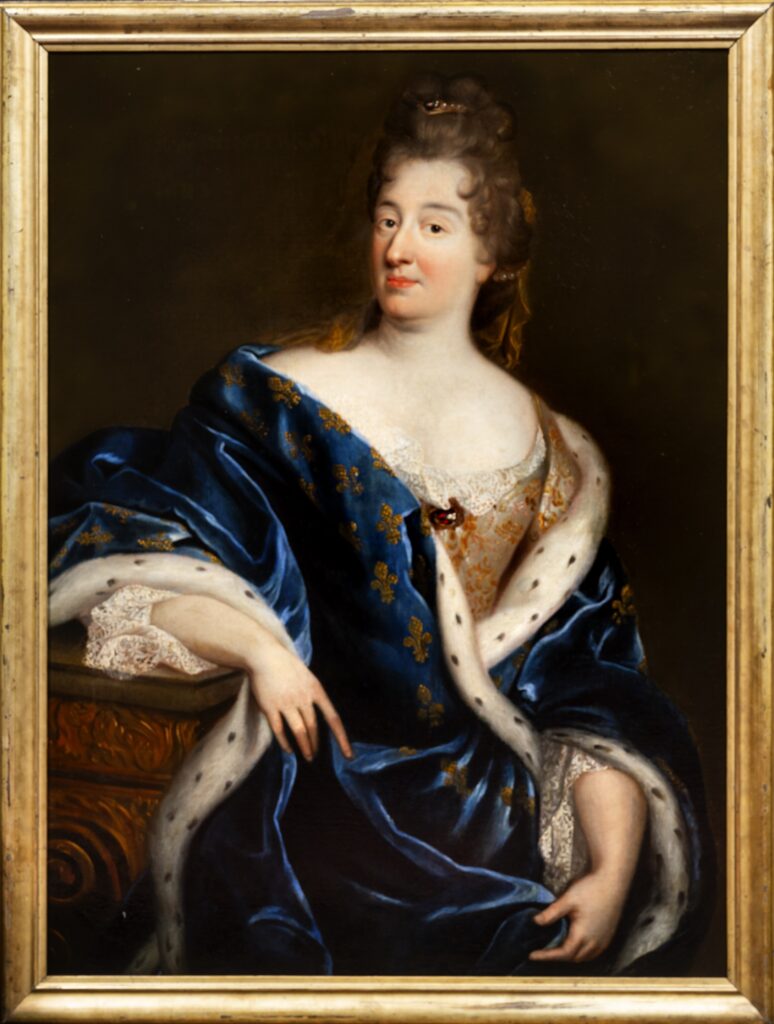
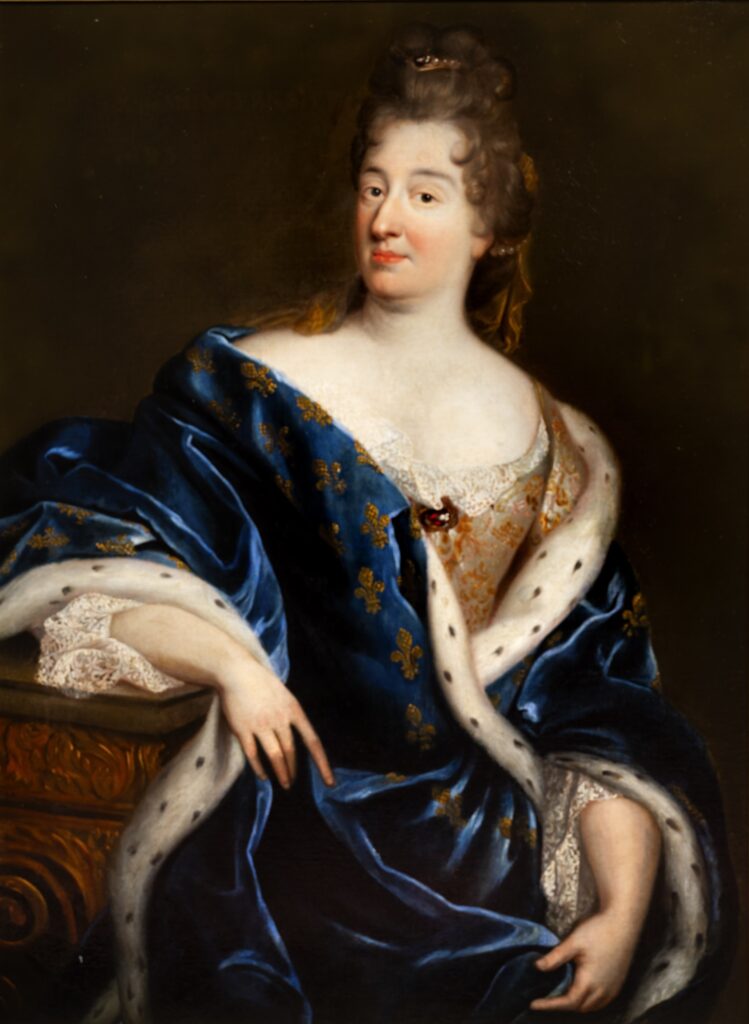
Portrait of Anne Marie Louise d’Orléans, Duchess of Montpensier
oil on canvas, cm. 112,5×85
The sumptuous silk gown, embellished with embroidery, lace and pearl jewellery, adorned with radiant golden fleurs-de-lis against a deep blue ground, allows the sitter in this important portrait to be associated with the prestigious French royal House of Orléans. Furthermore, an inscription on the reverse of the canvas identifies the subject as Princess Anne Marie Louise d’Orléans, Duchess of Montpensier (1627 – 93) one of the most influential and wealthiest women of the 17th-century French Ancien Régime. Better known as La Grande Mademoiselle, she left a profound mark on the political and intellectual life of France, notably through her participation in the Fronde of the Princes (1651), which saw Queen Anne of Austria, acting as regent on behalf of her son Louis XIV alongside Cardinal Mazarin, against the Parisian nobility supported by the Parlement of Paris.
Anne Marie Louise died unmarried and childless, bequeathing her vast estates and collections to her cousin Philippe de France, Duke of Orléans. Through dynastic succession, these subsequently passed to later generations of the French royal family. A crowned monogram on the reverse of the canvas, bearing the initials “LPO” together with the inventory number 195, suggests that the painting was part of the collection of one of the most distinguished of these descendants, King Louis-Philippe I, formerly Duke of Orléans, to whom the initials of the monogram clearly refer. Similarly to a number of works that have appeared on the art market in recent years, likewise distinguished by comparable inscriptions and monograms on their reverses, the painting was formerly housed at the Château d’Eu, the French residence once owned by La Grande Mademoiselle and likewise inherited by Louis-Philippe through dynastic succession. A further stamp on the reverse records the painting’s subsequent passage through Christie’s in London, most probably following the King’s death in England in 1850.
As regards the attribution, the splendour of the costume and the refined rendering of the flesh tones point to the hand of a highly accomplished portraitist such as François de Troy, one of the foremost exponents of portrait painting at the court of the Louis XIV. In both composition and style, the work displays significant affinities with paintings attributed to de Troy, including the “Portrait of Françoise Marie de Bourbon” (1692) and, above all, the “Portrait of Elisabeth Charlotte of the Palatinate” (c. 1680), both in the Palace of Versailles. These works echo not only the rich costume depicted in the present painting but also the pose and disposition of the sitter’s arms. Nevertheless, certain perspectival inconsistencies, particularly evident in the latter, suggest that the painting may instead be the product of a workshop or the work of one of the many accomplished portrait painters active in France during the 17th and 18th centuries, whose reputations remained overshadowed by such eminent masters as Pierre Mignard, Hyacinthe Rigaud and François de Troy himself.