


ITALIAN SCHOOL, after AGNOLO BRONZINO
19th century
Portrait of Stefano IV Colonna
oil on canvas, cm. 119×89
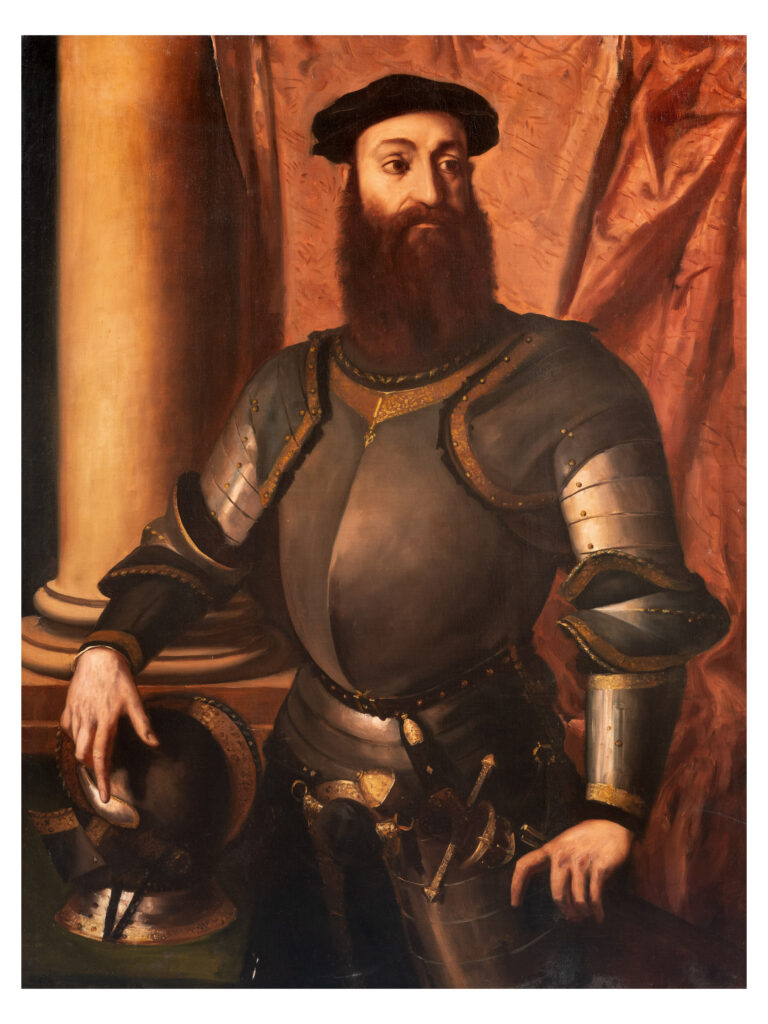
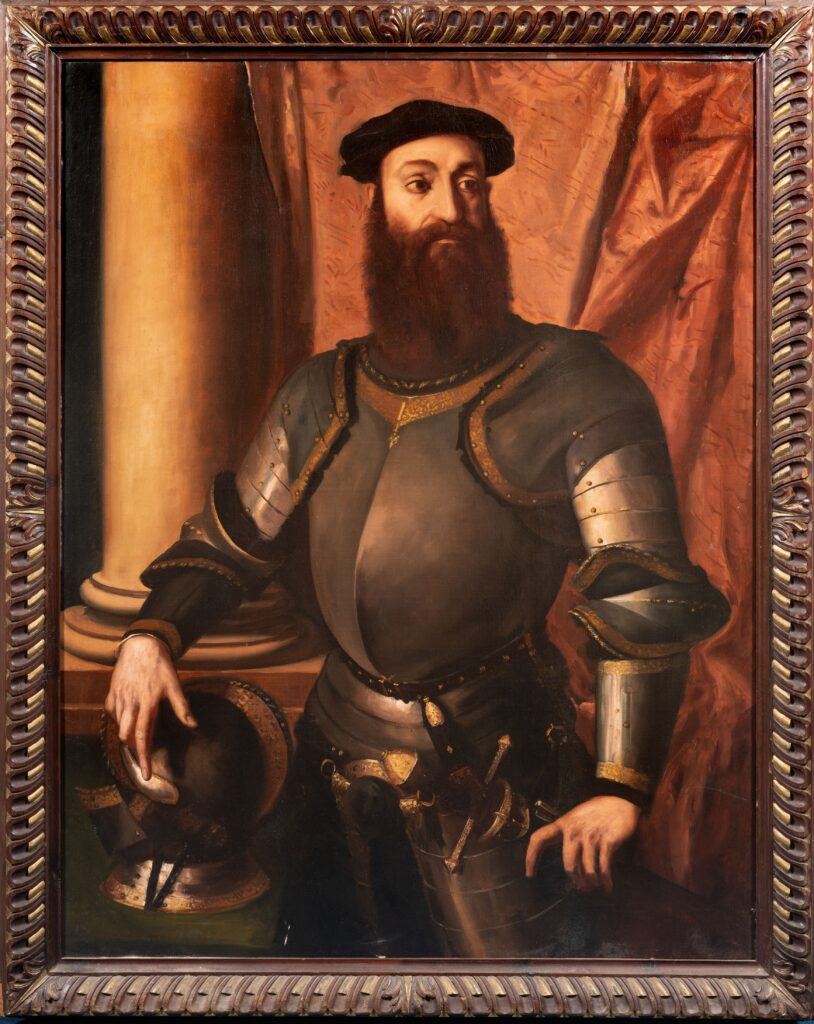
During the 19th century, the recovery and reinterpretation of Mannerist models became a widespread practice, particularly within academic circles, where close attention to the great masters of the past translated into exercises in study, reinterpretation, and stylistic transmission. It is within this context that the present painting should be situated, as it closely reprises the celebrated portrait of Stefano IV Colonna executed by Agnolo Bronzino, now at Palazzo Barberini.
The work stands out for its fidelity to the 16th-century model, clearly evident in both the construction of the figure and the overall compositional scheme. The condottiero is depicted half-length, clad in armour, with his face slightly turned and his gaze directed sideways, following a portrait typology that emphasizes the sitter’s rank and authority. The presence of the column in the background is not incidental; rather, it carries symbolic meaning, alluding to the stability and nobility of the Colonna family, while the drapery introduces a softer and more dynamic dimension to the composition.
Particularly noteworthy is the rendering of materials: the armour, gleaming and meticulously described in its details, demonstrates considerable technical skill, capable of precisely capturing the effects of light on metallic surfaces. At the same time, a distinctly 19th-century sensibility emerges in the chromatic modulation – warmer and more nuanced than the clear definition of the original – and in the handling of the brushwork, which appears looser and more rapid in certain areas of the painting, especially in the hands and in the decorative elements of the sword and the lower part of the helmet.
The sitter’s pose further reinforces an image of control and dignity: the hand resting on the helmet suggests confidence and mastery, while the other, placed with ease, stabilizes the composition. The face, framed by a full beard and a dark cap, remains impassive, reflecting the ideal of composure and emotional restraint characteristic of Bronzino’s portraiture.
Taken as a whole, the painting does not merely reproduce an image from the past, but bears witness to the persistence and continued relevance of Mannerist models within 19th-century visual culture, while simultaneously revealing an ongoing dialogue between tradition and modern interpretation.