

DIANA OF GABII
alabaster
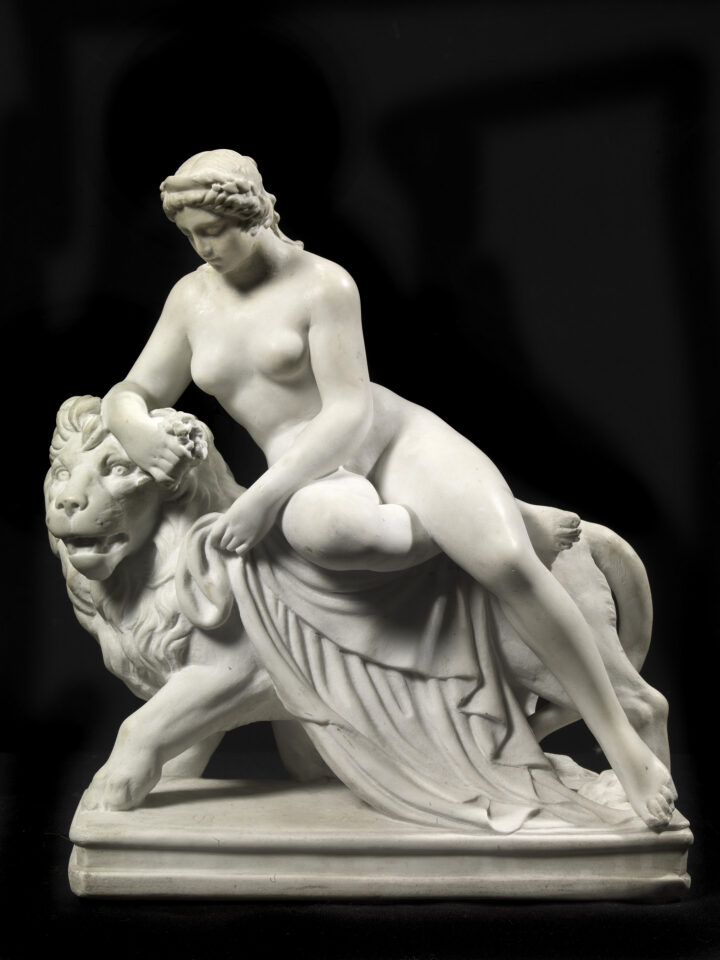
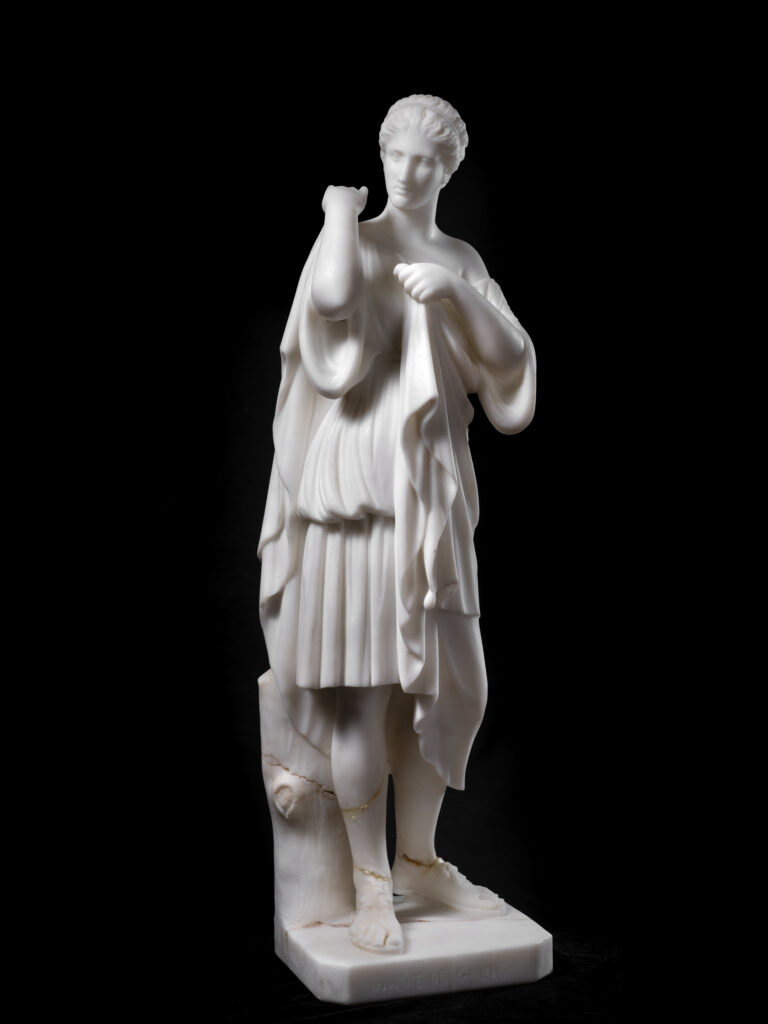
The alabaster sculpture presented here reproduces the celebrated “Diana of Gabii”, one of the most refined examples of classical statuary, traditionally attributed to the Greek sculptor Praxiteles or his circle. The original, discovered in the ancient city of Gabii near Rome, became part of the prestigious Borghese collection before being sold in 1807 to Napoleon and subsequently displayed at the Louvre Museum, where it is still preserved today.
The original sculpture depicts a standing young woman, carved at life size, draped in an elegant chiton. The pose is defined by a harmonious and natural balance: the weight of the body rests on the right leg, while the left, slightly set back with the heel raised, creates a dynamic and fluid line. A tree trunk serves as a support, a typical feature in ancient sculpture.
The identification of the figure as Artemis (Diana for the Romans), goddess of the hunt and the wilderness, is based primarily on her attire. She wears a short chiton with wide sleeves, fastened by two belts – one visible at the waist and the other concealed – which allows the garment to be gathered and shortened, leaving the knees exposed. The gesture of the figure is particularly significant: Artemis appears to be fastening her mantle, holding the fabric with a fibula in her right hand while her left lifts another section of the drapery to chest height. This movement causes the chiton to slip slightly, revealing the left shoulder and creating a delicate contrast between composure and naturalness.
The head, gently turned to the right, does not follow the action but appears absorbed, with the gaze directed into the distance, a typical feature of High Classical sculpture. The wavy hair is gathered at the back of the neck and secured with a tied ribbon forming a soft bow, enhancing the overall elegance of the figure.
As a whole, this 19th-century reproduction faithfully conveys the formal balance and grace of the ancient original, highlighting the quality of the modeling and the refinement of the drapery. The use of alabaster enhances the surfaces, giving the sculpture a soft luminosity and a particularly refined tactile quality, in perfect harmony with the ideals of classical aesthetics.
Neoclassical sculptor, early 19th century
cm. 40h