


GIOVANNI STANCHI
Rome, 1608 – 1675
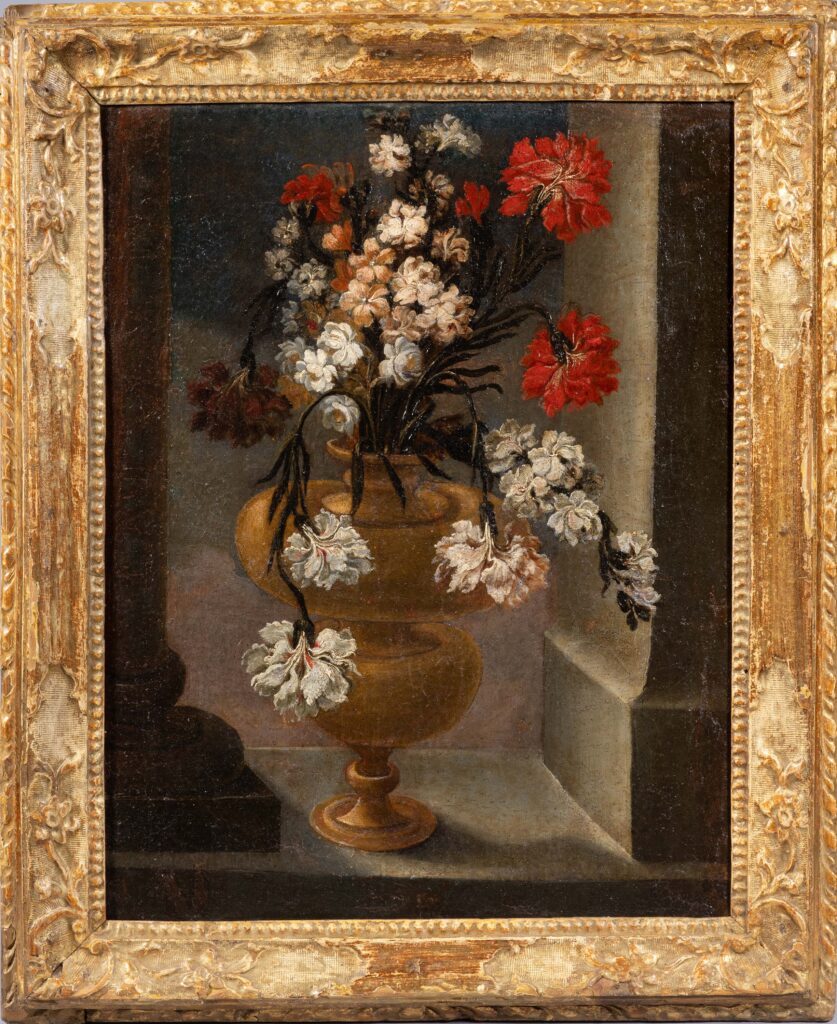
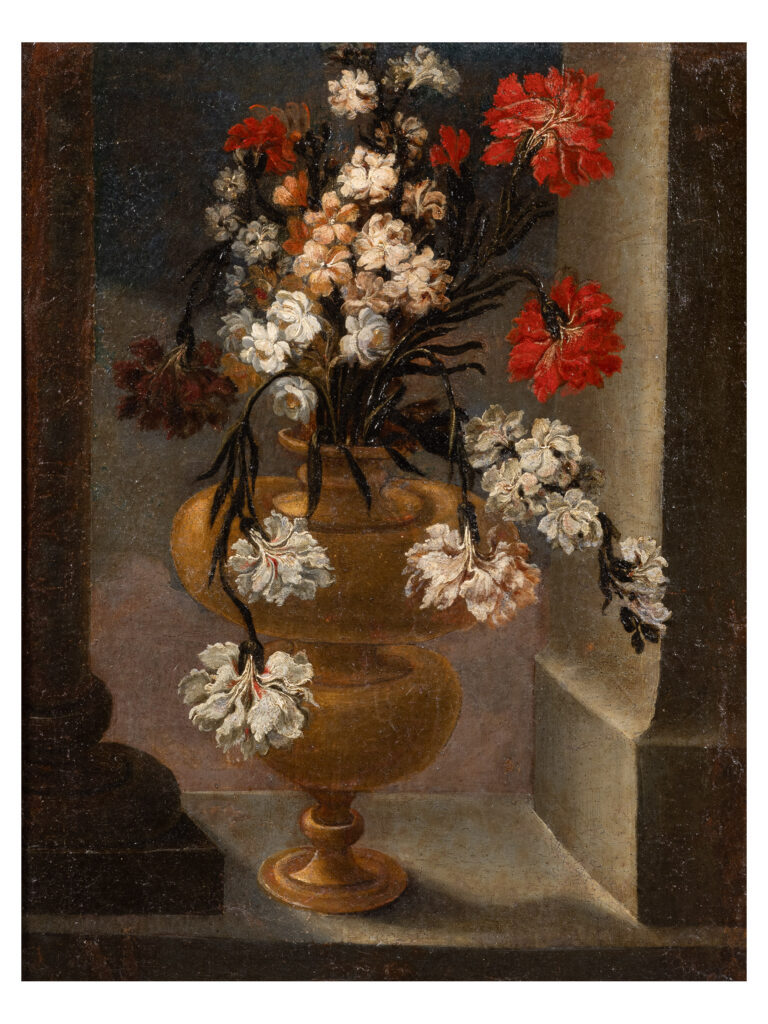
Still life with flower vase
oil on canvas, cm. 56×41,5
This still life, originally part of a pendant, depicts an unusual bronze vase containing a rich floral arrangement composed of carnations, roses, and double narcissi, arranged with studied naturalness upon a slab of pietra serena, set between a column and a plinth of the same material. The architectural framework, restrained yet significant, lends stability to the composition and introduces a spatial rhythm that guides the viewer’s eye towards the focal point of the painting, namely the bouquet, the undisputed protagonist of the scene. The work stands out for the quality of its painterly execution, evident in the meticulous definition of the petals, the translucency of the corollas, and the tactile rendering of materials, from the burnished metal of the vase to the compact surface of the stone. The neutral background, devoid of narrative elements, serves to enhance the luminosity of the flowers, which emerge with striking vibrancy through a skillful orchestration of colour and a carefully controlled use of light. The latter, falling selectively upon the surfaces, generates delicate reflections and heightens the volumetric perception of forms. As noted by Emilio Negro, who has studied the painting, the composition belongs to the genre of “nature in posa”, in which the arrangement of elements is not incidental but charged with symbolic meaning. The flowers, depicted at the height of their bloom, allude to the transience of life and the fleeting nature of beauty: a theme of Northern origin here reinterpreted in a warmer and more evocative tone characteristically Mediterranean vein. The selection of different species, some already on the verge of withering, reinforces the allegorical value of the image, transforming the scene into a silent meditation on time and the fragility of existence. From a stylistic point of view, the painting reveals the hand of a skilled flower painter of the Roman school, well acquainted with transalpine models yet capable of reworking them with greater expressive freedom. The brushwork, rich and assured, becomes more animated in correspondence with the highlights, giving rise to effects of particular liveliness. This sensitivity to light, combined with a preference for elegant and brilliant chromatic harmonies, allows the work to be confidently associated with the ‘modus pingendi’ of Giovanni Stanchi, known as “dei Fiori”, active in Rome in the second half of the 17th century. Comparison with several documented works by the master proves especially illuminating. One may consider, for instance, the “Vase of Flowers with Five Putti and a Little Bird” and the “Garland of Flowers with Four Putti”, both in Palazzo Colonna in Rome, or the “Still Life, Living and Dead, with Garland of Flowers and Butterflies” in the Pinacoteca Nazionale in Bologna. Even more direct is the comparison with the pendant preserved in the Uffizi Galleries, depicting a “Still Life with a Vase of Roses” and a “Still Life with a Vase of Flowers”. In these works, as in the present painting, one finds the same balanced construction, the same chromatic intensity, and that warm, full-bodied handling, characterised by effective highlights, which not only appear here but constitute one of the defining features of Stanchi’s mature production.