


PIETRO LIBERI, attributed to
Padua, 1605 – Venice, 1687
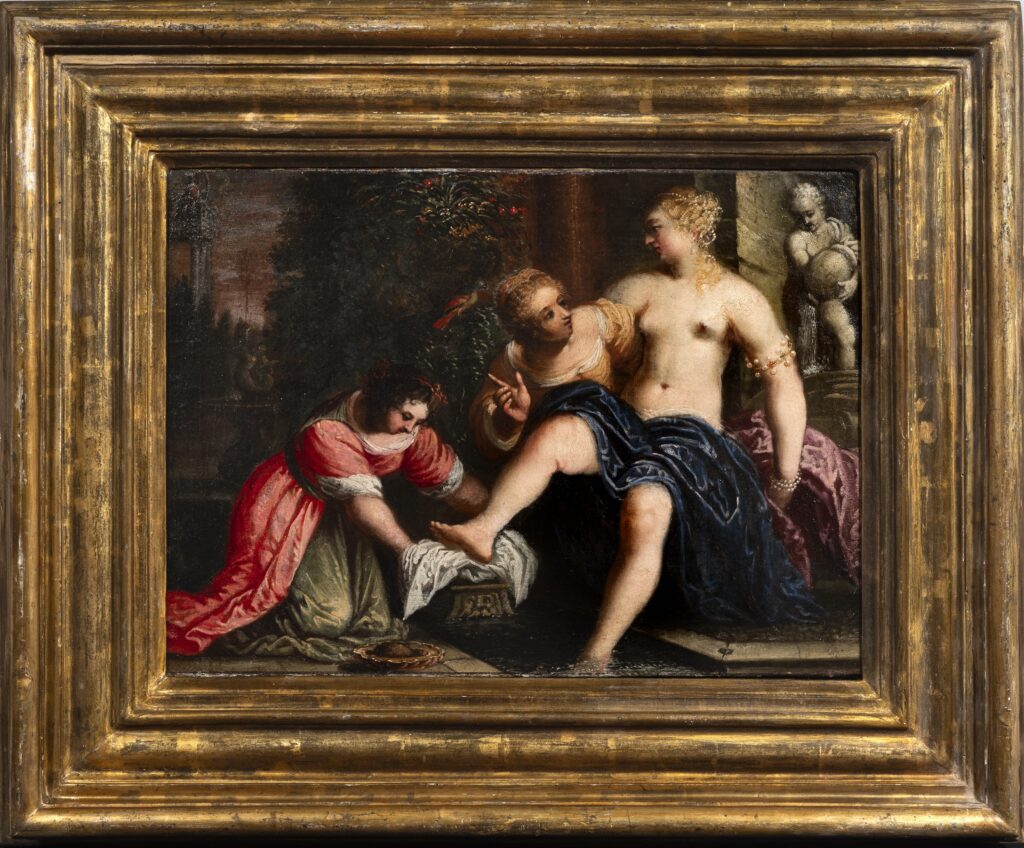
Bathsheba at her bath
oil on canvas, cm. 43×61
The biblical episode of Bathsheba at her bath, recounted in the Second Book of Samuel (2 Sam. 11), became an increasingly popular subject from the late 15th century onwards, particularly within Flemish and German artistic circles. Frequently employed as a pretext for the depiction of the female nude, this iconography enjoyed wide circulation throughout the 17th century and into the first quarter of the 18th. It was initially interpreted by leading figures such as Rembrandt van Rijn (1606–1669) and Peter Paul Rubens (1577–1640), and later within the Italian context in the works of Artemisia Gentileschi (1593–1653) and Massimo Stanzione (1585–1656), eventually reaching the protagonists of the late Baroque, among them Sebastiano Ricci (1659–1734) and Pietro Liberi, to whom our painting is attributed.
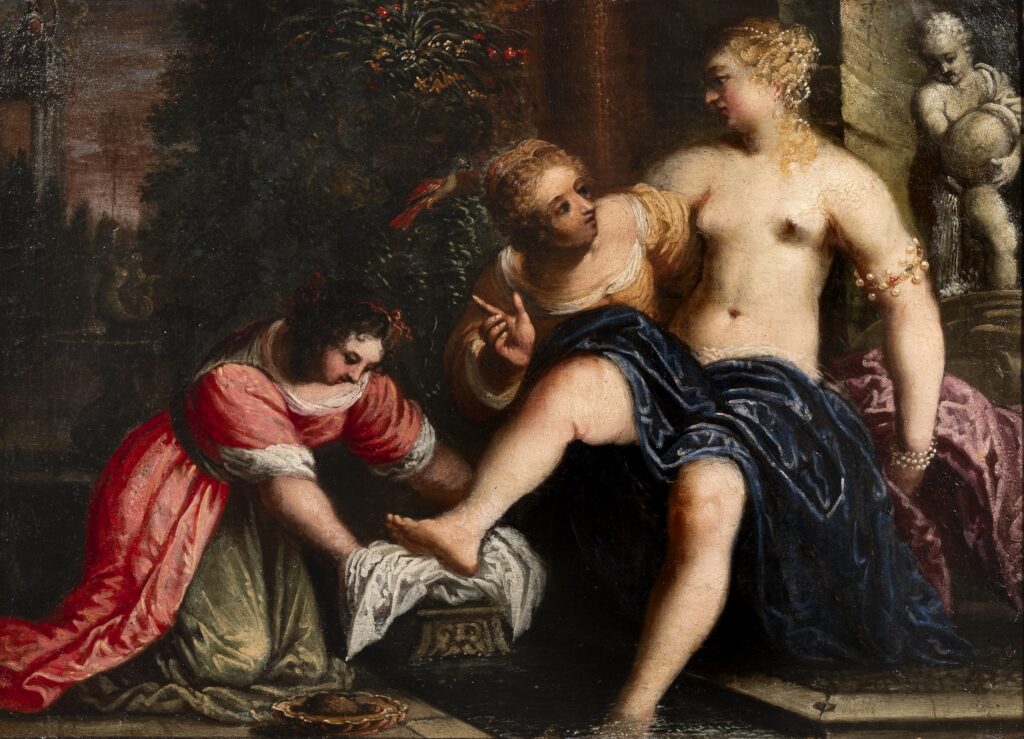
At the centre of the composition appears Bathsheba, the wife of Uriah the Hittite, an officer in the army of the biblical King David, portrayed while attending to the care of her body and appearance. She is assisted by two maidservants engaged in washing her feet, clothing her, and enhancing her figure through various toilette practices. In the upper left corner, from an elevated terrace with a balustrade, the silhouette of King David may be glimpsed, identifiable by the golden crown he wears, depicted at the very moment in which he observes Bathsheba and becomes enamoured of her. According to the biblical narrative, David subsequently summons her to his palace and, despite being aware that she is another man’s wife, impregnates her. When he fails to pass the child off as the son of Uriah, David orders that Uriah be sent to the front lines, effectively condemning him to certain death. The child born of this adulterous union dies a few days after birth, interpreted within the biblical account as a manifestation of divine punishment.
The subject appears to have been particularly favoured by Pietro Liberi’s patrons and recurs several times within his artistic production (eg. the youthful canvas now in the Museo Civico of Belluno to the more mature examples of the Alte Pinakothek in Munich and the Staatliche Kunstsammlungen in Kassel). From a stylistic perspective, although certain passages reveal a degree of attention to detail, such as Bathsheba’s hairstyle, consistent with 17th-century Venetian fashion, or the elaborate bracelet she wears, the rapidity of the brushwork, the relative economy of the representation, and, above all, the modest scale of the painting suggest that it may have functioned as a preparatory study for a composition of larger dimensions. Within it, Liberi appears to have experimented with a number of compositional solutions, particularly in the gestures of the maidservants and in the articulation of the pictorial space. These features are consistent with the painter’s characteristic idiom, renowned for representations animated by figures of pronounced sensuality, often marked by a certain licentiousness, which contributed to his fame throughout the 17th century, no less than the episodes of his adventurous and restless life.