


GIOVANNI DI TANO FEI
Doc. in Florence from 1386 to 1409
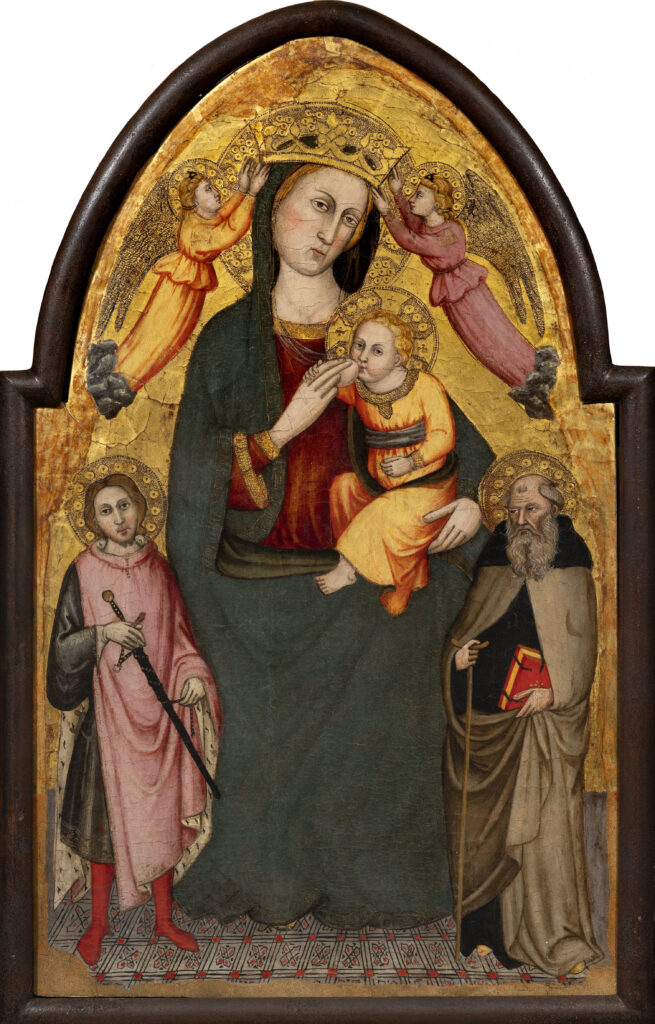
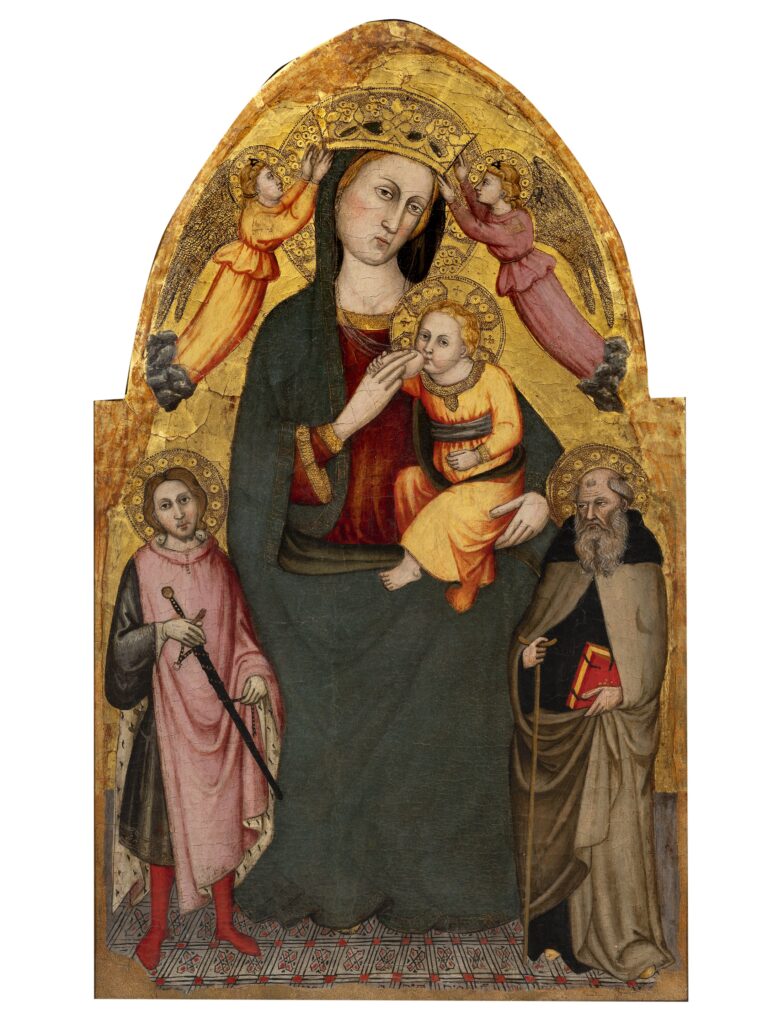
Madonna and Child enthroned, crowned by two angels, between Saints Julian the Hospitaller and Anthony Abbot
tempera and gold on panel, cm. 77,5×49,5
Originally intended for private devotion, this important panel portrays the Virgin seated on a throne concealed by an ample mantle, richly decorated with gold at the edges, as she offers her breast to the Child, who looks toward the viewer while suckling. On either sides, a pair of angles in adoration emerge from clouds, placing a golden crown upon the Virgin’s head, which is directly stamped onto the gold leaf of the background. In the foreground, in smaller proportions, stand Saint Julian and Anthony Abbot, set against a grey and red tiled floor – a combination quite typical of Florentine painting between the late 14th and early 15th century.
In exceptional conditions and known to both Federico Zeri and Everett Fahy, the work comes from the prestigious collection of the Hohenlohe-Langenburg princely family of Madrid, and has recently been attributed by Mauro Minardi to the hand of the late Gothic Florentine painter Giovanni di Tano Fei. Documented in Florence from 1386, the year in which he is recorded in the Arte dei Medici e degli Speziali as a “pictor cofanorum” (painter of cassoni), until 1409, when a payment is recorded for a panel he executed for the altar of Saint Peter Martyr in the church of Santa Maria Novella, Fei may be described, in Minardi’s words, as a ‘petit maître’ who worked primarily in the Florentine milieu during the last fifteen years of the 14th century and the first two decades of the 15th.
Fei’s artistic personality was first reconstructed by Miklòs Boskovits, who grouped a number of panel paintings around the “Madonna and Child Enthroned with Angels” (dated 1399) from the Serristori Hospital in Figline Valdarno – hence the original name by which the painter was identified by Boskovits, “Master of 1399”. Fei’s style is distinguished by a certain descriptive inventiveness, in which composure and balance of composition and figures blend masterfully with a touch of expressive eccentricity. These traits place Fei’s works firmly within the late 14th-century neo-Giottesque tradition, epitomised by the work of Taddeo and Agnolo Gaddi, and Jacopo di Cione, while also anticipating the trends in Florentine late Gothic painting exemplified by artists such as Gherardo Starnina and Lorenzo Monaco.