


Bartolomè Gonzalez Y Serrano
Valladolid, 1564 – Madrid, 1627
date: after 1596
oil on canvas, cm. 189×110
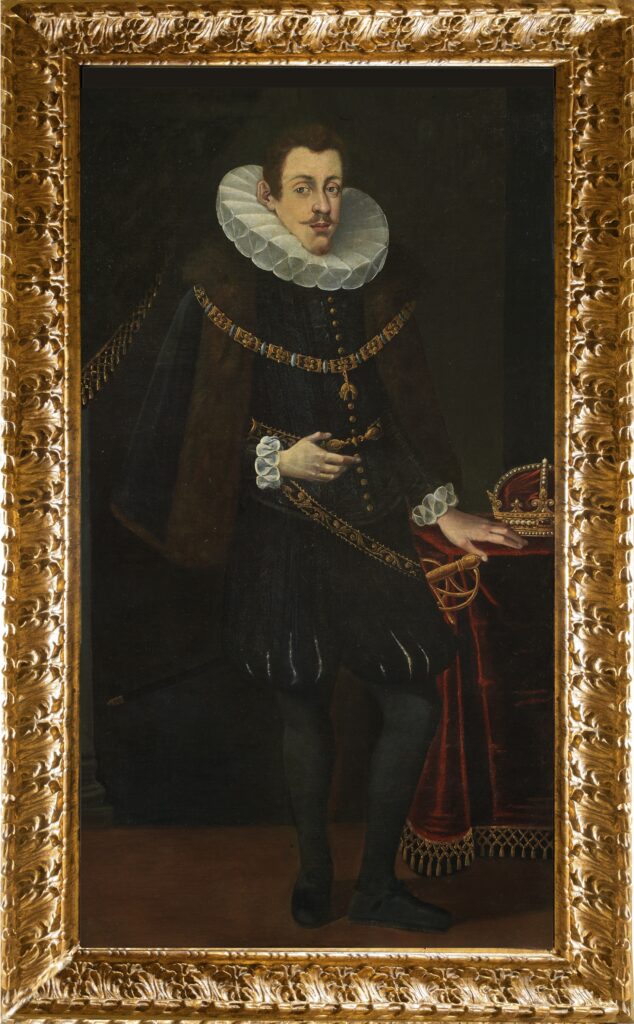
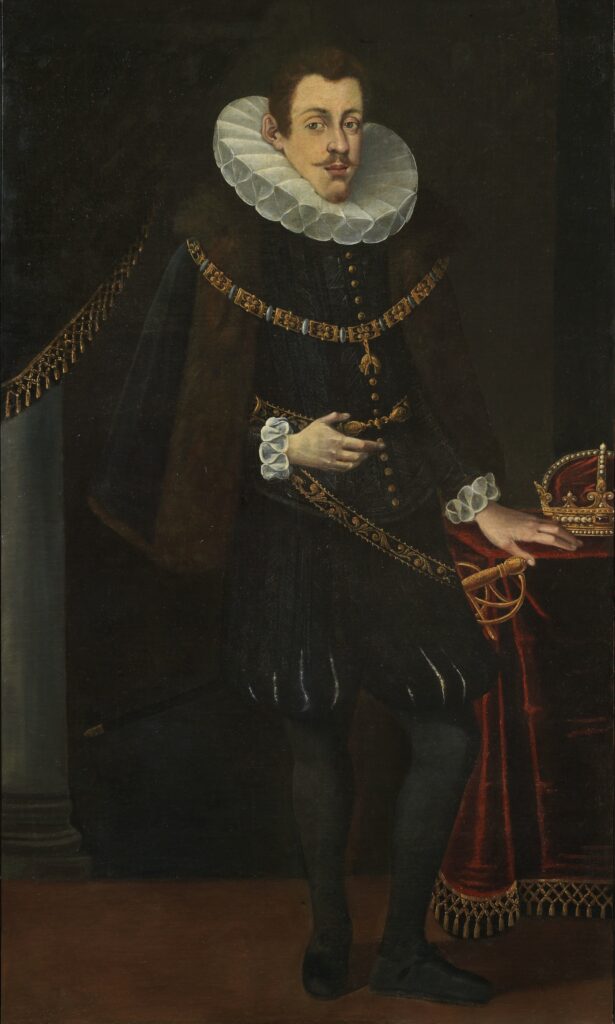
The figure depicted in this full-length portrait, shown beside a royal crown and proudly wearing on his chest the collar of the Order of the Golden Fleece, has been identified by the scholar Alessandro Nesi, on the basis of the physiognomic features of the face, framed by a magnificent ruff, and his membership in the prestigious order founded by Philip the Good of Bourgogne in 1430 as the king Philip III of Spain (1578-1621). This identification is confirmed by a painting very close both in composition and in painterly treatment, preserved at the Smithsonian American Art Museum in Washington.
The youngest son of Philip II and his wife Anna of Austria, he ascended the throne in 1596 following the death of the couple’s other sons. In the same year, he received the Order of the Golden Fleece, a date which, according to the scholar, may serve for the dating of this painting and in any case provides a secure terminus post quem for its execution.
Nesi has suggested attributing this canvas to Bartolomé González y Serrano, “a pupil of Philip II’s court portraitist Juan Pantoja de la Cruz, who was also trained in the tradition of portraiture established by Alonso Sánchez Coello”, and who was active for a long time in Madrid, where he became a court painter. According to the scholar, stylistic elements compatible with the Spanish artist can be recognized in our painting, such as “the rather sharp definition of the transition between shadow and light” and “the approach to painting the fabrics of curtains and draperies with folds that tend to remain relatively flat and with a pronounced velvety effect”, visible in other works by the painter, such as the “Portrait of Infant Cardinal” of the Monastery of the Encarnación in Madrid, or in the portraits respectively of Don Fernando of Austria and the infant Anna (Vienna, Kunsthistorisches Museum).