


AGOSTINO MASUCCI, attribuito a
Rome, 1691 ca. – 1758
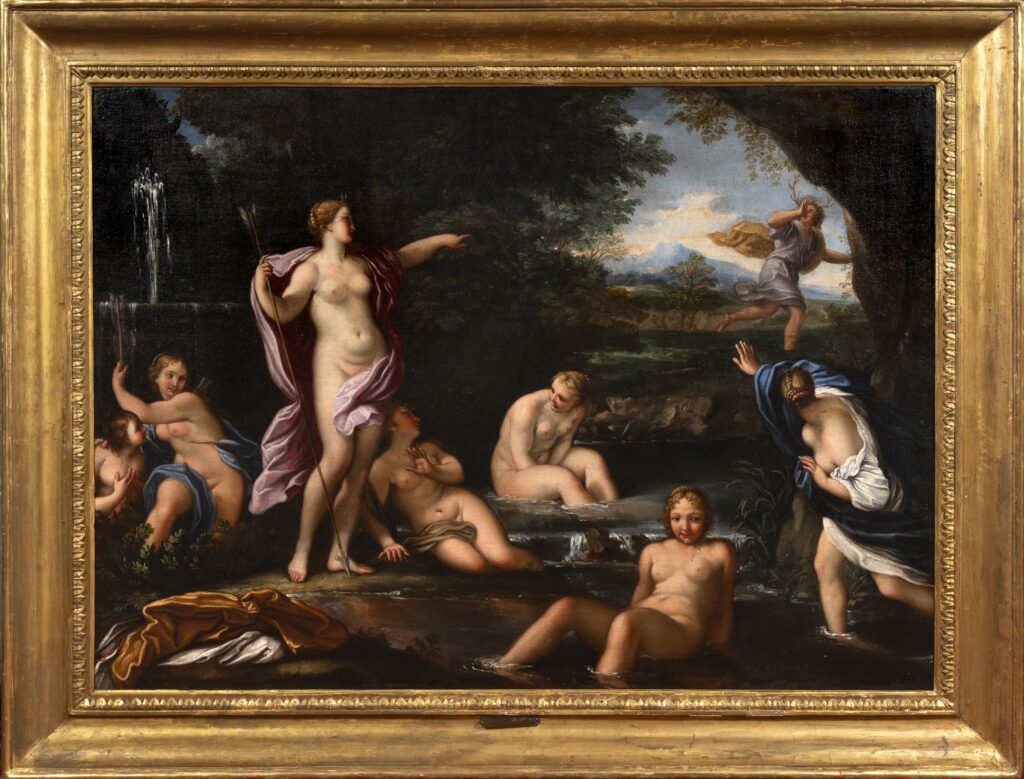
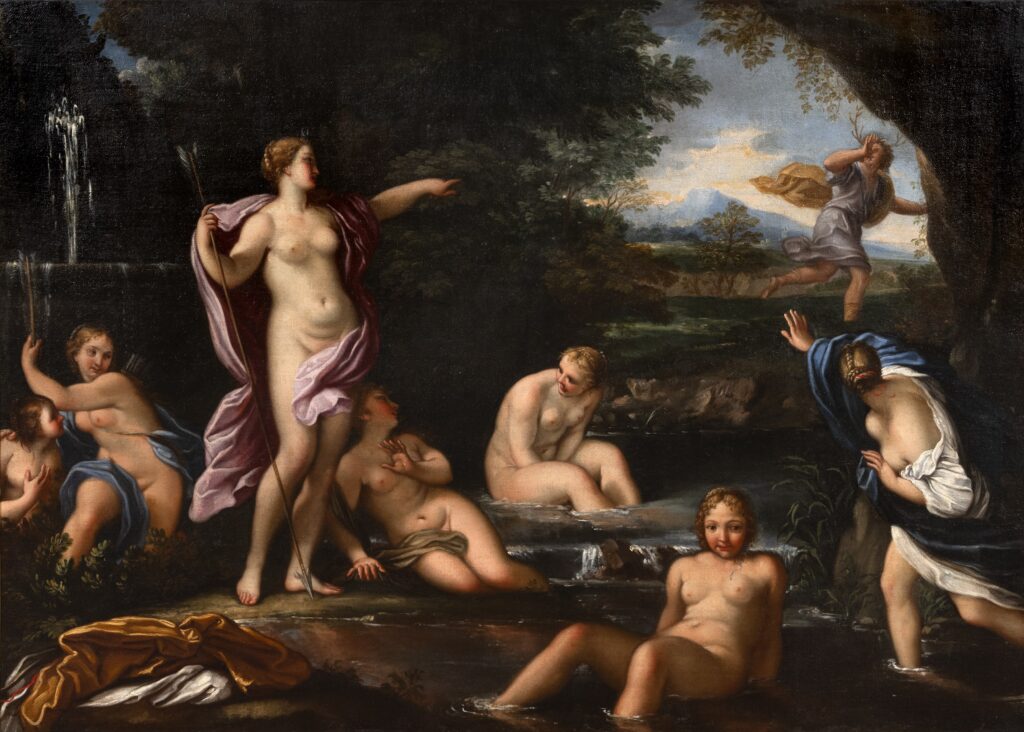
Diana at the bath and Actaeon
oil on canvas, cm. 98×135
The painting depicts the renowned mythological subject of Diana at the Bath with the Nymphs, drawn from Ovid’s “Metamorphoses”, and follows the iconographic model established by the celebrated painting by the Marche-born artist Carlo Maratta (1625–1713), executed with the contribution of Gaspard Dughet (1615–1675) for Prince Lorenzo Onofrio Colonna (c. 1660). The work later entered the collection of the Marchese Pallavicini and was acquired in the eighteenth century by William Cavendish, 4th Duke of Devonshire. The painting, replicated in numerous versions by both the artist and his prolific workshop, is now preserved in the Devonshire Collection at Chatsworth, England.
The scene unfolds in a wooded, shadowed landscape, illuminated by a cool light that brings the foreground figures into sharp relief. At its centre, Diana stands with majestic authority, draped in a pinkish-violet cloth that partially covers her nude body. Around her, the nymphs are depicted in relaxed poses, enjoying a bath amidst the natural setting. In the distance, Actaeon can be seen, moments before being transformed by a stag by Diana, having dared to spy upon the goddess and her nymphs.
From a stylistic standpoint, the painting may be attributed to a pupil operating within Maratta’s workshop, Agostino Masucci, a prominent figure in the Roman art scene of the 18th century. Born in Rome around 1691, he began his training as an apprentice to Andrea Procaccini (1671–1734), but the decisive moment in his artistic development came with his entry into Maratta’s studio, the dominant force in Roman painting from the late 17th to the early 18th century and a key figure in the Classicist academic tradition of the period. Masucci absorbed from his master the emphasis on drawing, composure, and the so-called “bella maniera”, becoming a typical representative of Roman Arcadian academicism in the eighteenth century, marked by formal elegance, compositional harmony, and a predilection for poetic and mythological subjects, in keeping with the tastes of the Accademia dell’Arcadia.
Nevertheless, Masucci subsequently established himself independently, receiving significant institutional recognition, including his admission to the Accademia di San Luca in 1724 and culminating in his election as Principe of the institution in 1736–1738. A stylistic and iconographic comparison of his works with those of his master shows that Agostino Masucci was not merely a follower of Carlo Maratta’s teachings, but also served as a vital link between the Baroque classicism of the 17nth century and the emerging Arcadian and pre-Neoclassical taste of the 18th century.