


JEAN FRANCOIS COURTOIS
Saint Hippolyte, 1627 – information until 1673
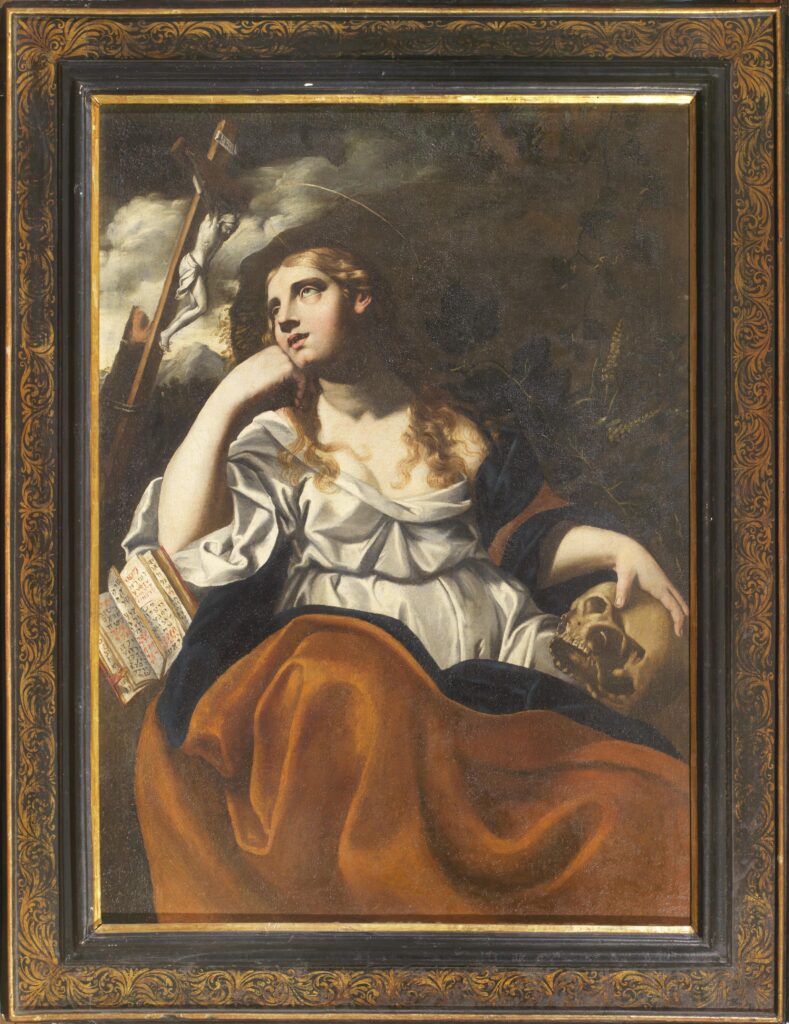
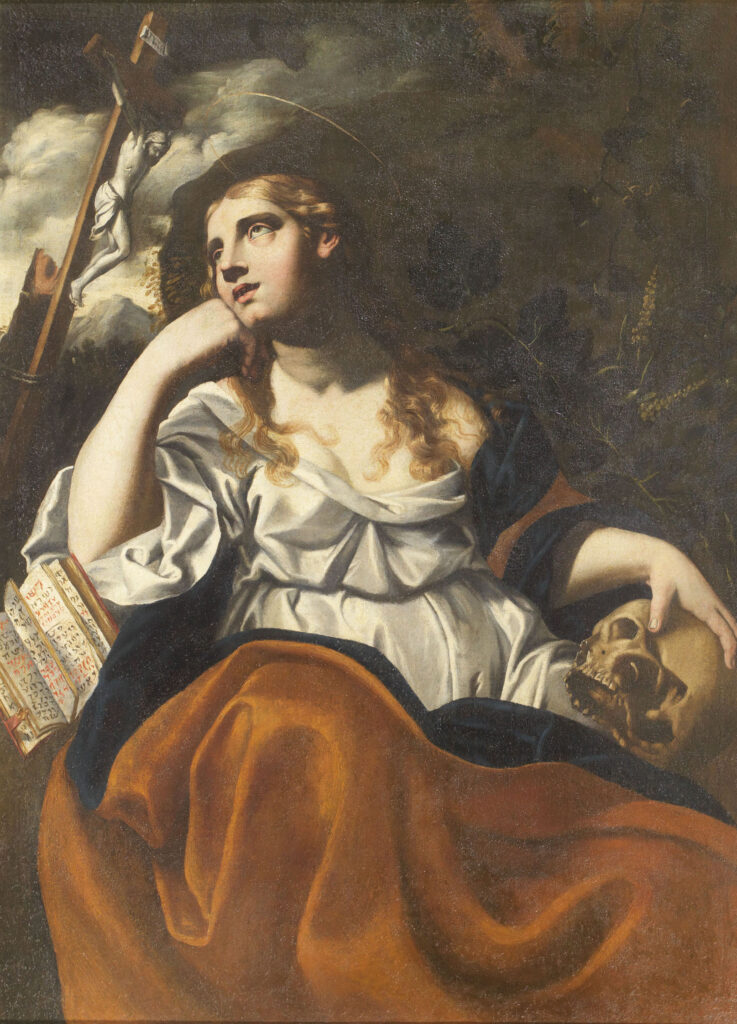
Magdalene in meditation
oil on canvas, cm 129×95
This pendant depicts two celebrated female figures from the biblical and Christian tradition: Judith, the Old Testament heroine, and Mary Magdalene, one of the most frequently represented saints in the history of painting. In the first painting, Judith appears armed with a sword before a marble table on which rests the freshly severed head of the Assyrian general Holofernes. The subject refers to the episode narrated in the Apocrypha of the Old Testament, in which, during the siege of the Jewish city of Bethulia, the wealthy widow Judith entered the enemy camp pretending to have abandoned her people. Having gained the trust of Holofernes, who became infatuated with her and organized a banquet in her honour, she waited for the right moment; when the general, overcome by wine, fell asleep, she beheaded him, thus saving her city. The second canvas depicts Mary Magdalene in meditation before the Crucifix, according to a devotional iconography that became widely popular in the 17th century, promoted by the spirituality of the Counter-Reformation and by the contemporary emphasis on repentance. The saint is shown seated, three-quarters length, her gaze turned toward the Crucifix and her face supported by one hand in an attitude of intense contemplation. Her long flowing hair and the refinement of her garments allude to her past as a prostitute, while the presence of the skull – traditionally a symbol of vanitas and an attribute of hermits – recalls her conversion and her subsequent life of penance and spiritual retreat. From a stylistic point of view, the two paintings are characterized by a robust and richly coloured pictorial language, which has allowed the scholar Emilio Negro to attribute these works to Jean-François Courtois, brother of the celebrated battle painter Jacques Courtois and of Guillaume Courtois, all known by the nickname ‘Borgognone’. Having arrived in Rome with his brothers around 1639, Jean François withdrew about twenty years later to the convent of Palanzana, where he took the name Giovanni Antonio da Sant’Ippolito. Our paintings share with the artist’s production the solidity of their pictorial structure, their lively chromatic range, and taste influenced by the great Roman Baroque painting tradition, particularly the example of Pietro da Cortona.