


MASTER OR MONOGRAMMIST G.M.
(GIOVANNI BATTISTA MARCOLA?)
First half of the 18th century
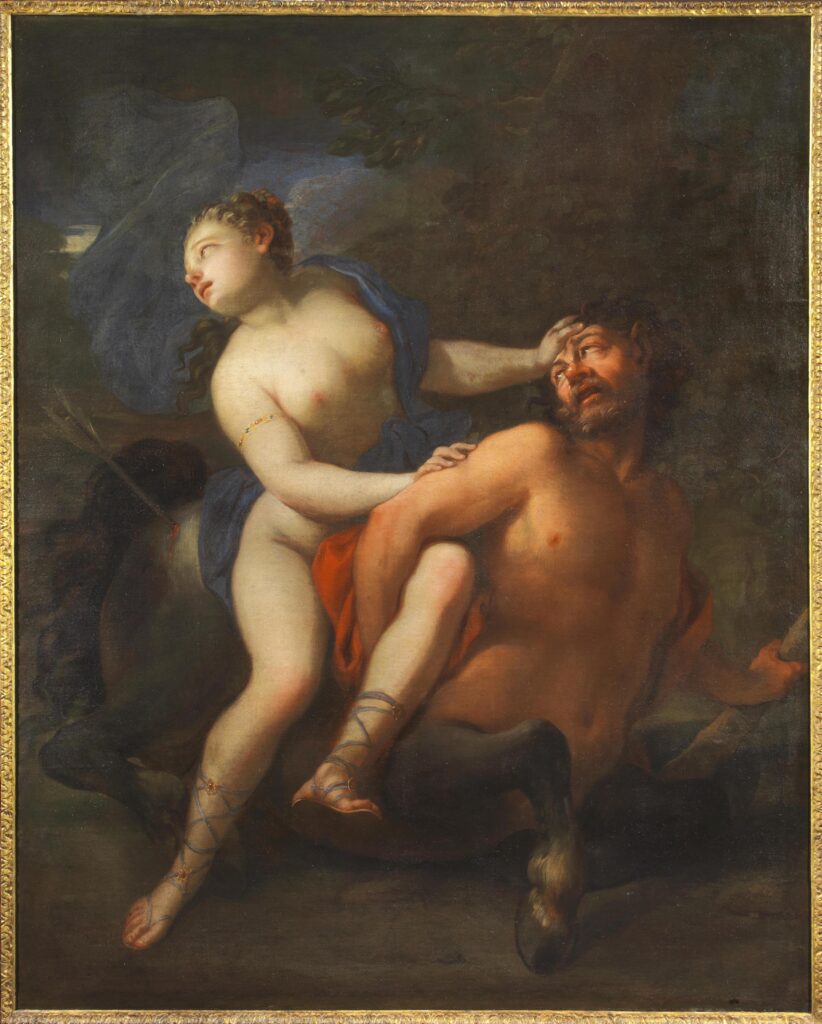
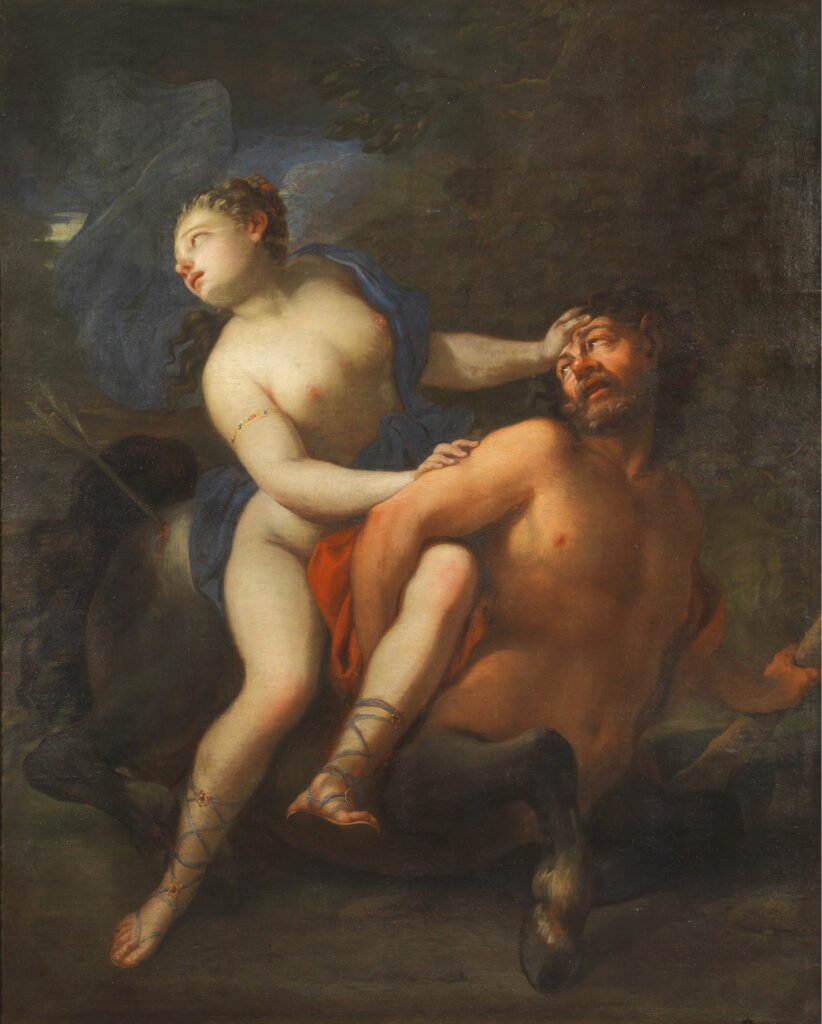
The abduction of Deianira
oil on canvas, cm 183×148
signed: G.M.F.
The painting provides a visual transposition of a celebrated episode narrated in the “Metamorphoses” by Ovid. The demigod Hercules and his wife, the beautiful Deianira, find themselves obliged to cross the flooded river Evenus. The centaur Nessus offers to ferry the young woman across upon his back; however, having reached the middle of the ford, he attempts to abduct and violate her.
The composition is highly expressive and marked by an extraordinary dynamic emphasis, characteristic of mature Venetian Baroque painting, in which a neo-Veronese theatricality frequently constitutes the dominant aesthetic principle. Along the lower margin may be read the initials “GM” followed by an “F”, a signature that unfortunately remains unresolved and has therefore been associated with an anonymous painter conventionally identified as the “Master GM”.
Although no documentary evidence survives concerning the provenance or even the broader cultural background of this artistic personality, the painterly ductus – the fluid and supple handling of colour – and the dramatic yet luminous chiaroscuro clearly indicate that the artist was trained within the orbit of the eighteenth-century Venetian school, or at the very least drew heavily upon its powerful chromatic models.
The painting also bears a date, legible as 1739; both the date and the stylistic characteristics suggest a possible identification of the so-called Master GM with Giovanni Battista Marcola, a Trentino painter of Veronese culture who was active during the opening decades of the century until his death in 1776.